
Tony Evans - Trusting God in a Storm (03/24/2018)
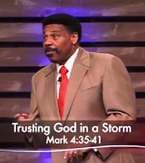
In Mark 4's account of Jesus calming the storm, the preacher teaches that even in God's will, believers face uncontrollable "lailaps"—fierce, unexpected crises causing circumstantial, emotional, and theological turmoil—but faith means acting on Jesus' promise ("to the other side") over feelings, waking Him in prayer so His word overrides the storm, leading to deeper discovery of His divine power amid human frailty.
In God's Will, Yet in a Storm
We have been talking about faith. We defined faith as acting like God is telling the truth. Faith is measured by feet, not by feelings. Faith is measured by walk, not by talk. Faith is measured by life, not by lips.
Jesus has been teaching all day. He has been teaching the crowds, preaching the big sermon, and then he takes his disciples aside, and he gives them a private Word. He says in verse 33 of Mark 4, "With many such parables he was speaking the word to them, so far as they were able to hear it; and he did not speak to them without a parable; but he was explaining everything privately to his own disciples."
Beginning in verse 35, he tells his disciples, "I want you to get on the boat and let us go," verse 35 says, "to the other side. Leaving the crowd, they took him along with them in the boat, just as he was; and the other boats were with him." So, let us get something straight as we start our journey. The disciples are smack-dab in the will of God. Jesus said, "Get in the boat." They got in the boat after the sermon, but while in the will of God and on the boat with the Lord, there is a problem.
The problem is described in verse 37, "There arose a fierce gale of wind, and the waves were breaking over the boat so that the boat was already filling up." The Greek word here for "fierce gale of wind" is "lailap." A lailap was a tumultuous storm coming out of nowhere on the Sea of Galilee, so this ought to clarify, as we have tried to do all along, that storms in and of themselves do not tell you whether you are in or out of God's will.
What tells you whether you are out of God's will is did you do what he told you to do? But whether you did it or you did not do it, you can still be in a lailap. That is, a tumultuous situation. The other thing you need to know about this lailap is it is merciless. That is, it comes down on you, and it seeks to consume you. The boat was filling up. The wind was blowing at such speed that it threatened to take them under.
Anybody ever been in a situation that looked like it was going to take you under? That it was going to drown you. That it was going to overwhelm you. A storm, this kind of trial, is an unexpected circumstance that invades your life, that threatens your very existence. We are not talking about a headache or toothache here. We are talking about a situation where your life is on the line, where you do not know if you are going to make it or not, but let me tell you something else about a storm.
A storm is always designed to increase your faith and give you a deeper experience with your God. Storms are unpleasant, they are uncomfortable, and sometimes they can be life-threatening, but they always come with a purpose.
Three Storms in One Crisis
So, here they are in a crisis. They are in this crisis, and the crisis was three-fold. There are actually three storms occurring here. Let me walk you through the three storms. First of all, there is a circumstantial storm, the lailap.
I will say one more thing about this circumstantial storm, and that is it was a storm over which they could exercise no control. You cannot control the wind. You cannot control the sea. You cannot control the rain. You cannot control the spinning of the turmoil. You cannot control waves billowing up and going—you cannot control that. That is out of your control.
So, you can be in the will of God and in a storm and absolutely be able to do nothing about it, because you cannot control a lailap. It is circumstances that produce a helpless and sometimes the feeling of a hopeless scenario. So, that is storm number one. That leads to storm number two. Storm number two is that they were terrified.
We know that they were terrified because Jesus is going to say to them, "Why are you afraid?" in verse 40. So, they were not scared. They were stirred. Now, we are talking terrified. So now, we not only have a storm of circumstance, we have a storm of emotion, because their emotions have riveted up, and they are scared about the doctor's report, scared about the financial struggle, scared about the relationship direction, scared. Whatever it is that you cannot control that is causing your emotions to be uprooted is your lailap, because it is something so big, so deep, and so devastating, you cannot control it.
So, the first storm are circumstances out of their control. The second storm is their emotional instability because of the uncontrollable circumstance, but there is a third storm here. We will call it a theological storm, because not only was the circumstance out of control and now their emotions responding to that circumstance, they now have a spiritual storm, a theological storm, because the Scripture goes on to say that they woke up Jesus and said in verse 38, "Teacher, do you not care that we are perishing?"
See, that is a spiritual storm because their circumstances were out of control and their emotions have gone crazy. So, what I heard about you and what I am experiencing do not match, and I am not sure this is real. If we were to tell the truth and shame the devil, there have been those times when we have raised the question, like Martha and Mary, "Where were you when I needed you? Because if you would have been here, it would not be this painful, it would not take this long, and it would not hurt this bad. Teacher, do you really care, or is that just theological nonsense I was raised to believe?"
Let us go a little deeper, because verse 38 says, "Jesus himself was in the stern, asleep on the cushion." No, you did not. Oh, no, you did not, Jesus. I am in a storm, and you are snoring. I am in a storm, and you are sleeping. What good is a Savior who sleeps when you are in your storm? So, not only is Jesus asleep, not only is he asleep on purpose, he is asleep in a storm.
Okay, now I got another problem, because he is sleeping on me and he is in the same storm I am in, because he is on the same boat I am on. He is asleep on a storm, and the only way he gets up, if I got to wake him up. It said they woke him up, so he is sleeping. So, Jesus, why the storm not messing with you? Because the storm messing with everybody else on this boat, and you are sound asleep.
Does Jesus care about my pain, my finances, my loneliness, my hurt, my depression? Because I am in his will, and I feel all this. And so, they wake Jesus up. Verse 39, Jesus gets up, and he rebukes the wind and says to the sea, "Hush your fuss." Hush, be still."
Notice who Jesus is talking to. He going to talk to them, but he is not talking to them right now. He is talking to the circumstance. The circumstance is the wind and the sea. It is the storm. He does not speak to them yet. He speaks to the situation, but when does he speak to the situation? After they wake him up. So, Jesus is asleep. They wake him up. When they wake him up, he speaks to the circumstance that was causing the crisis.
So, do not let it be said your crisis continues because you never took the time to wake the Savior up. In other words, you were not so concerned about it. That getting his attention to it was unimportant, because we will wake up our friends, we will wake up people with power, we will wake up people who we think can change it, and a lot of times we do not try to wake up the Savior. And so, Jesus now turns to his disciples, "Why are you afraid?" verse 40. "How is it that you have no faith?"
Promise Over Problem
Now, I do not know about you, but I have issues with the question. I got issues with that question, because that question does not make sense to me. They wake Jesus up, the boat is filling with water, they are in a lailap, it is a terrible storm, they do not even know whether they are going to live or die, and Jesus is going to ask a question like that? "Why are you afraid, and why do you have no faith?"
Oh, I do not know, Jesus. Maybe it is because we are getting ready to die. Well, that takes us back to verse 35, because in verse 35, Jesus said, "Let us go to the other side." Not, "Let me go to the other side." You left shouting. You were excited to get in the boat with me, but when the circumstances showed up, they overrode what I said.
In other words, your problem overrode my promise, so you are now living in light of the problem, no longer living in light of the promise. And when you live in light of the problem and no longer in light of the promise, the problem will dominate you, and it will totally erase the fact I ever made one. God never wants your circumstances, he does not want you to deny them. A storm is a storm, you know? You do not call it a sunshine day. A storm is reality, but he never wants your circumstance to trump his Word.
Not only does he not want your circumstance to trump his Word, he does not want your circumstance to trump his presence, because he is on the boat, too. You are doing exactly what I told you to do, but because of the next level I am taking you to, I will appear to be asleep. You will not hear anything from heaven. Oh, but when he spoke, he told the wind, "Chill. You just chill." He told the sea, "Shhhh." And when Jesus spoke to the circumstance, the circumstances changed, so the issue in a lailap is not your ability to change the circumstance.
The issue in a lailap is your communication with Jesus so he can speak to it, because, obviously, if it is a lailap, it is out of your control. So, the issue is Jesus speaking to it. The problem was not them waking Jesus up. That was not a problem of faithlessness. That was a good thing, because he responded when they woke him up. The problem was the faithlessness that woke him up.
Discovery of Who Jesus Is
And so, Jesus speaks to the problem, and when he speaks to the problem, there is a circumstantial change. And then it leads to a conclusion, and, oh, what a conclusion it is. Verse 41 says, "They became very much afraid." Okay, when they were in the lailap, they were afraid. When they saw who they were dealing with, they became very much afraid. In other words, we are afraid of the wrong thing. See, we let our circumstances scare us.
He says, "When you know who you are dealing with, you will be less afraid of that and more scared of me, because, shucks, if I could tell the storm to calm down, what can I do with you if I am ticked off at you? I will shut you down, shut you out of here." No, if you are going to be scared, then what you need to be is more—your fear ought to be toward who I am, not what the circumstance is, because once I get up, all I got to do is talk to it.
I wonder has anybody here ever seen God talk to a situation, you know? It was out of your control, nobody you knew could help you, you did not have money to buy your way out of it, and God said something. Heaven spoke to it, and, whoo, suddenly, immediately, out of nowhere that thing changed. So, it is more important to by faith get Jesus dealing with a circumstance than you living in fear. Do not be scared of the wrong thing.
And they ask a question, because they are scared now, "Who then is this, that even the wind and the sea obey him?" Who, then, is this? Obviously, we do not know who he is. Let me tell you something. When Jesus is—humanity is asleep, his deity stays awake. Who, then, is this? They were on a journey of discovery. Trials, as inconvenient and as painful as they are, are a journey of discovery of who you are dealing with, okay?
God has placed you—it is not convenient, and I am not trying to make light of it, but you are in a situation where God wants you to know who you are dealing with. See, they had seen some things about Jesus, but Jesus is saying, "They do not know who I am yet. They do not understand who they are dealing with yet, so let me show them a little something, something." He changes the circumstances. Bam, overnight he tells them that "your faith is not where I want it to be yet." And they say, "Who in the world is this?"
See, because too many of us still got him in a manger somewhere. Too many of us do not know who we are dealing with here. I mean, he is tired, so he got to go to sleep, because he is human. He gets up, and he puts the lailap to sleep because he is God, okay? Because he is God, because he is human. We call this in theology the hypostatic union. The hypostatic union means two natures in one person unmixed forever. Two natures and one person unmixed forever, so he is both human and divine.
One moment, he is dying on a cross. Another moment, he is raising folk from the dead. Come on, who are you? What manner of man is this? Hebrews 4 says and we have a high priest who is able to sympathize with our pain. How can you sympathize with my pain? Because I am human, so I can feel what you feel the way you felt it, but I am divine. See, when I go to you or you go to me, that is human to human. I may be able to sympathize, but not be able to fix it. But when you deal with the God-man, you are dealing with someone who can feel it and fix it.
God says, "Because I am a man, I know how you feel. But because I am God, I can do something with it." What manner of man is this that even the circumstances, nature, obeys him? Nature has to succumb to him, if you have a lailap. And if you do not have one, keep living. You will. God wants to take you to a place of understanding in him that you have never been before.
The Cruise Ship Storm Illustration
And I tell a story about this major event that took place in our lives, in the Pacific Ocean, when we had—"The Urban Alternative," our national ministry, we had a trip for people who support the ministry to Alaska, and that is where I ministered to people who listened to the radio broadcast, supported the ministry from across the country. We had about 700 people on the boat, and on our way back from Alaska, the captain said, "We are going to hit a storm. We are going to hit a storm, and it might be a little rough".
It was more than a little rough. It was the worst storm Royal Caribbean had ever had in their history. The waves were hitting the boat 40 feet high. Sister Evans, bless her heart, was very upset because they did not use the Inside Passage coming out. So, you can come from Alaska open ocean, or you can come through the Inside Passage. Well, if you come through the Inside Passage, mountains are all around you, so you would not feel the weather like that, but they had to get back because they had to drop us off and get another one—you know, it is money for them.
So, they were on open ocean, so we were just out there, and what was worse is the captain knew we were going to be out there. He told us we were going to be out there in a storm. He did not tell us how bad it was going to be, but he told us we are going to be in a storm, so Sister Evans is like—a little bit evangelically ticked off. So, we are in the cabin, because everybody went back to their cabin, and she picks up the phone and says, "May I speak to the captain, please?" I am sitting on the bed going—she says, "May I speak to the captain?"
She calls the operator, and she says, "I want to speak to the captain. I do not know why they did not take the Inside Passage. We have guests on this boat, and this is a bad experience for them and makes our ministry look bad, you know?" She said, "Well, the captain cannot come to the phone right now because he is weathering the storm, so I am sorry, but we will relay your concern."
A few minutes later, the phone rings. It is the assistant captain. The assistant captain says, "Ma'am, we know you are upset. We know you know this is a bad situation, but I need to tell you something, and that is this boat was built with this storm in mind. When we were on dry dock and we put this boat together, we knew we would hit a day like this. That was calculated in the building of the boat. So, even though it is an uncomfortable journey, you are going to be fine, your guests are going to be fine, because before we ever left it had already been established that we would be able to handle a day like this."
Let me explain something. Jesus told them, "Let us go to the other side." That was on dry dock. He said, "Before we ever leave, I am going to tell you where we are going to wind up. We are going to get to where we are supposed to go." Now, there may be rough sailing between leaving here and coming back here, but your salvation and your Savior was built with your struggle in mind.
He has not forgotten you, your struggle, your pain, or your purpose, and he knows how to get you from point A to point Z, even if you have to go back to B and go to T, to wind back at F, to go to X, in order to get you there. He knows how to take you from here and get you there because it was built with you in mind, including your struggle.
The Turkey Timer and True Readiness
Let me wind it down. Look, Thanksgiving you are going to be putting in a turkey, and many of you will have a timer, and the timer will go off when the time is indicated that the turkey is done and ready to be eaten. Bing, it is time, and you will pull the turkey out the oven, and it will look crispy brown because the timer said it is time and it is ready.
But I know a serious cook is going to take one of those long forks with those two prongs, and you are going to stick it inside, because you are not going to buy it just because the timer said it, nor are you going to buy it just because the outside makes it look like it is ready, because you want to go deeper to find out whether what it looks like on the outside is as real as it is on the inside. And if when you put your fork in there, it is not ready, you are going to put it back in the oven, reset the timer until it gets ready. Because you are not satisfied that it looks ready on the outside, you want to know that it is ready on the inside.
Everybody right now look ready. Everybody in here right now looks done. Everybody in here looks like you are ready to go and take care of your storm, oh, but God is going to stick a little fork in there because he wants to find out was that just a Sunday look, were you saying a Sunday amen, or is there something on the inside taking place with his Word? So, I want all you turkeys to stand up and recognize that God wants to take you through your storm in victory. Wake him up. Keep your eyes on him. Make him Lord.