
TD Jakes - When God Smells Honor (10/10/2020)
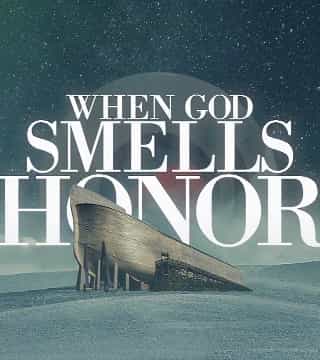
Noah, emerging from the ark into a world of death and loss, chooses to build an altar and offer a costly sacrifice of gratitude to God, demonstrating true worship even in pain—and because God smells this honor rising like smoke, He vows never again to destroy the earth with a flood, promising seedtime and harvest forever.
Building Your Own Altar
Every person, no matter how close you are to them, has to build their own altar. I cannot build your altar for you. I love you, but I cannot build your altar for you. You have to have your own altar, your own place, your own hookup, your own connection, and you have to build it. It does not come prefabricated; it does not come already erected. You have to build it.
And so, Noah builds an altar. This morning, I want to ask you: What are you going to build? What did God put in your life—the raw materials that need to be built—and you are complaining because it is not already built? I gave you the wood. I am not going to make the chair; I gave you the wood. Whatever it is, it is what it is as a result of what you built.
If You Want It Better, Build It
You want it to be better? Build it. You want to enhance it? Build it. You want a better relationship? Open your mouth and start communicating. It is not going to happen if you do not. You want God to bless your business? God will bless your business, but He can only bless what you build. He will bless it, but He will not build it.
That means you have to get off the phone with those people talking about other people. I am sixty-two years old, and I have never met a rich gossiper. I do not know any rich gossipers. Every gossiper I know is broke, because rich people do not have time to be in your business. They have to be building their own stuff.
Check the record—every gossiper I ever met. If you are taking care of my business, you do not have time to take care of your own. Touch three people and say, “Build it, build it, build it.”
Responding to God in Difficulty
This is really, to be honest, a weird Bible story. It is not a cool Bible story, because all these people are dead except eight. This is a catastrophe, a calamity of mammoth proportions. These eight people need therapy, counseling; they might need medication. No wonder Ham freaks out later.
The question becomes: How do you respond to God when He does something you do not like? You always preach it real pretty about them coming out, but they are coming out amongst all these dead bodies. The real test of a true son is how you respond when I did something you do not like.
The Bible says if you endure chastening, then you are sons and not bastards. If you are an illegitimate child, when I chastise you, you can walk away. But if you are really My son, with tears in your eyes, you are going to come back to Me because you came out of Me.
The True Test of Sonship
God says the test of sonship is how you react to unpleasant things. Anybody can praise Him when He is doing stuff you like. Can you praise Him on a kidney machine? Can you praise Him in a hospital bed? Can you praise Him at a graveside? Can you praise Him when you get laid off? Can you praise Him when you are scared?
Now we are talking about real Christians. You see how the shout range went way down? Half the people in the room only praise God when they get good news. But if you are really His child, you will praise Him when you do not understand it, when your heart is broken, when you are upset.
I was struck by the story of Thomas Dorsey writing “Precious Lord.” With a dead wife and dead baby buried in the same casket, he stumbles to a piano and builds an altar, not understanding why God would give something and take it away. He does not complain or get bitter; he pens the words: “Precious Lord, take my hand. Lead me on, let me stand. I am tired, I am weak, I am worn. Through the storm, through the night, lead me on to the light.”
Noah’s Sacrifice of Gratitude
It is that spirit that made Noah step out of the ark, gather wood, and build an altar. He offered a sacrifice—not a tip, not a toy, but a sacrifice. A sacrifice means God does not want you giving Him stuff you cannot feel, because if you cannot feel it, He cannot either. What makes a sacrifice a sacrifice is its significance to you. It is a statement of value.
Noah says: I know I should have drowned too, and You had mercy on me. You let me succeed where others failed. You let me get in where others were locked out. You let me complete what others stumbled in. You let me survive what my friends did not survive, even though I did the same things they did.
So I am building this altar and offering this sacrifice partly as an admission that I should have died too. I offer these animals in my stead. This is the gospel—You took my place. He offered a burnt offering, which is always a sin offering.
An Admission of Undeserved Mercy
Had He dealt with me according to my sins, I should have drowned with the rest of them. You did not make it through school because you were better; you made it because He was merciful. You did not get what you got because you were better; you made it because He was kind to you.
Do not stick your nose up in the air and act like you are something. Bring your nose down to this altar. Noah says: Before I do anything else, I have to build this altar and say thank You, God. Thank You for letting me live, my wife live, my children live.
Is there anybody in this house that is grateful? He went to the altar to worship. “We have not cooked in forty days, I am hungry, I want a meal, but I will eat later. I am giving the protein to You.” For Thine is the kingdom, and the power, and the glory forever. Amen.
A Sacrifice You Cannot Take Back
It is important that he set it on fire, because when you set something on fire, you cannot take it back. You cannot reach in and get it. You cannot give it to God and take it back in the car, in your house. When you give something to God, you put it in the fire.
None of that is what drove me to the text. It was that when he put the sacrifice on the altar on earth, God smelled it in heaven. The whole story is about when God smells honor.
The last verse we quote—“While the earth remaineth, seedtime and harvest, cold and heat, summer and winter”—those are not God’s spoken words. It was God’s thought. When He smelled the sacrifice, God said to Himself: No matter how wicked they get, I am not going to do that anymore.
When God Smells Honor
There are some things I will never take you through again because I smell honor. Later He tells Moses: Honor thy father and thy mother that thy days may be long upon the earth.
We have a lot of church people who come to service, but out of this great crowd, only a few offer a real sacrifice and give God true honor. If there is anybody under the sound of my voice who has something to be thankful for, do not wait on anybody else—build your altar, offer your sacrifice, and give Him honor.
If He brought you through anything, if He healed your body, renewed your mind, brought your child through something, then get on that altar and give God praise. Real worship is a smoky business—a heart set on fire. When God smells honor, He gives promises. He will heal your land, but He cannot do it until He smells honor.
Right there in your living room, by your couch, let God smell honor like smoke coming out of a chimney. For Thine is the kingdom, and the power, and the glory forever. Amen.