
Steven Furtick - The Hardest Part Is Behind You (02/16/2026)
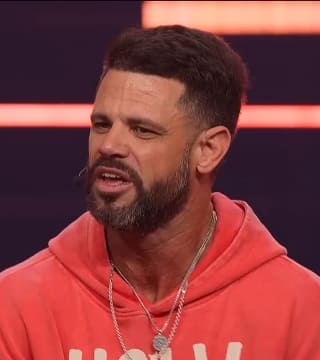
In part two of «That’s What I Thought,» Pastor Steven Furtick preaches from 1 Corinthians 13:8-11 about putting childish ways behind us and prioritizing the permanent over the passing. Using Naaman’s story from 2 Kings 5, he shows how our expectations («I thought») can block God’s healing process, but obedience turns the hardest part behind us into restoration and new beginnings.
Opening Praise and Welcome
Let’s give the Lord 20 seconds of praise that he gave Jesus the name that is above every name and he gave us that name to call on today. What a beautiful name it is, the name of Jesus Christ our King. Well, you might want to turn around and introduce yourself to five people. Tell them your name. «Hello. My name is…» Let’s get on a first-name basis. If you’re watching online, put your name in the chat. Who are you? Where do you come from? I’m pulling out my phone right now to see who’s joining us across all of our streaming platforms. Just go ahead and put your name in the chat. If you’re watching this at a later time, put it in the comments. And, Elevation Church, let’s thank God for our eFam watching all over the world right now.
As I heard somebody say, «You can do better than that.» One time, I heard a preacher preaching out in the country, and he didn’t like the response he was getting from the church. He said, «You can do better than that!» Somebody in the crowd shouted, «So could you!» Don’t do that today. We have trained security who know martial arts. I’m so glad you’re here today. I’m so thankful not only for the sermon I’m about to preach to you but the sermon that you preached all week long.
Gratitude for LOVE Week Service
Everybody who served during LOVE Week, large or small, thank you. Everybody who gave so we could be out there, thank you. Man, I wish you could have seen me and Holly and your campus pastors and your outreach staff just giving out checks left and right this week to feed the hungry, to lift up the brokenhearted, to bind up the wounded, and to make a difference in somebody’s life. I wish you could have seen my son Graham with a power tool in his hand. I told him, «Son, I can’t teach you what to do with that. The only power tool I ever held was a microphone to preach the gospel.» So many people this week made a difference, and if you are one of them, I say, «Thank you.» If you were not one of them, it is never too late to get in on a good thing. I said, it’s never too late to get in on a good thing. May today be a day of new beginnings.
It’s also a day of continuations, because I have started a series called That’s What I Thought. Look at your neighbor and say, «That’s what I thought.» That’s what I thought. That’s what I thought. «You want to say something now? That’s what I thought.» I like that energy when we run up on the Devil on Sunday versus when he runs up on us on Monday. Come to church talking about «Chains break! Dry bones wake!» The key to all of this is that when we are not together like this, you are able to take what you get here and apply it there, wherever your «there» may be. That is my desire for you, and that there would be no place that the Word of God could not make the difference in your life.
Scripture Reading: 1 Corinthians 13
Today, I’m excited to share a message with you, and I’m going to use for a foundational Scripture 1 Corinthians 13:8-11. As you’re looking in your Bible, let me welcome a few eFam from around the world. We have Rebecca, Sharika, Sherylann, Diane, Leisha, and Laura. We have Bremerton, Washington; Flagstaff, Arizona; and Vicki from Texas. God bless you from all over the world. Just keep letting us know where you’re watching from. We want to connect with you.
Today, as I share a principle and then a picture… I love to teach that way. That’s my favorite way to teach: a principle and then a picture. A principle and then a picture, so you can hear a sermon and see a sermon. We’re going to do both today. First Corinthians, chapter 13, which is normally a Scripture you only hear at a wedding. I don’t know if somebody is getting married today or if the Lord sent me to prophesy, but I’m preaching from 1 Corinthians 13, specifically from verses 8-11, which is not commonly what they read at the weddings. This is one of the most powerful «I thoughts» in the Bible.
I talked last week about a «God thought» and an «I thought.» An «I thought» can sometimes lead you in isolation. It can lead you to do things that are impulsive. It can lead you to insecurity. I. All those start with the letter I. So, we’re exchanging that now for God thoughts. The most famous «I thought» in the Bible is in 1 Corinthians, chapter 13. Let me start with verse 8 to give context. And we don’t stand the whole time. We’re just standing for the reading of God’s Word, because it’s his Word, and he’s holy, and he’s amazing, and he deserves it. We give him our full attention. So, everyone standing to your feet. Listen to the Word of God.
«Love never fails. But where there are prophecies, they will cease; where there are tongues, they will be stilled; where there is knowledge, it will pass away. For we know in part and we prophesy in part, but when completeness comes, what is in part disappears.» Here’s the verse I want to read you. «When I was a child, I talked like a child, I thought like a child, I reasoned like a child. When I became a man [and got this hair on my chest]…» «When I became a man [and got these grays in my beard]…» «When I became a man, I put the ways of childhood behind me.»
The Message: The Hardest Part is Behind You
The title of this message is a declaration today. Turn to your neighbor and say, «I don’t know what you’re going through.» Look right at them and say, «But the hardest part is behind you.» I knew it. I knew that was the word of the Lord. The Devil fought me all night last night, telling me, «You can’t stand up and preach that. What if they have something negative in their future this week? What if they have something disappointing in their future this week? You don’t know what they’re going through.» The word of the Lord is The Hardest Part is Behind You. Tell three people, «It’s behind you.» Put it in the chat. On your way to your seat, tell them, «It’s behind you. It’s behind you. It’s behind you.»
Credit where credit is due, I stole that title from Holly. It’s something she says when we go out on Elevation Nights. (We are coming to a city near you soon in October, so go to elevationnights.com.) Usually, after a few songs, Holly and I will take the stage and welcome the people and greet them, and it’s always so exciting. We thank them for coming, and we make a few little jokes. Then she always tells the people something like this. I may not get the wording exactly right. She’s like, «I don’t know what you had to go through to get here tonight. I don’t know if the parking deck was a mess. I don’t know if your babysitter canceled. I don’t know if you had the stomach flu earlier this week, but you decided to come contagious anyway.» «Just relax now, because the hard part is behind you. You’re here.»
I can kind of see, when people sit down after she says that, maybe they’re glad to hear that or maybe they’re a little skeptical, because you can’t really say that to them, because they still have to get out of the parking garage after the concert. So, they know, like, «Okay. Well, the hardest part is not behind me, technically, because I have to actually leave, and then I have to go back home where I don’t have an amazing worship team singing songs of praise to me and where everybody is not a Christian. I have to go back to a job where not everybody believes like I believe.» Yet there’s something about when she says it that I think is so important. She’s just letting them know, «Everything the Enemy could have done to keep you from getting here tonight… You made it. Now just take it in and receive it.»
I want to say that to those of you at Elevation today. You got here. You got here. You bought a plane ticket or took a scooter, but you got here. You bummed a ride, paid for an Uber, but you got here. There’s something encouraging about when she says that. «The hardest part is behind you. Now just receive. Just sing. Just worship God.» You’re like, «Yeah, that’s so good to hear,» whether you’re in the middle of a worship service or a workout.
We Know in Part: Passing vs. Permanent
I used to do this thing called P90X with DVDs, and the man would tell you about 40 minutes through the workout, «Now the hardest part is behind you. It’s all downhill from here.» It was good that he said that, because I was just about to hit stop on the DVD and get a partial credit for the day. But there’s something about hearing that. «The hardest part is behind you. You’re done with the hardest part. Everything from here on out is just a cooldown. Everything from here on out is going to be fine. The hardest part is behind you.»
Of course, there are parts of your life and parts of my life that the other one doesn’t know. I’m not sure what all of the parts of your life that you are considering today or the parts of your life that have led you to this moment have been, but I do know the apostle Paul says something so profound in 1 Corinthians 13:8, which is a wedding Scripture. Remember? The people getting married, after they read 1 Corinthians 13 and the wedding is over… They think that when the wedding is over, the hard part of the relationship is over, after they have sailed in bliss to their honeymoon. So, it’s kind of ironic that I’m using this chapter to teach this principle.
He says something about love never failing, and then he says, «Where there are prophecies, they will cease; where there are tongues, they will be stilled; where there is knowledge, it will pass away.» Verse 9: «For we know in part…» Everybody say, «We know in part.» Use your mouth and say it. «We know in part.» To me, that Scripture keeps me humble. To me, that Scripture keeps me open. That Scripture keeps me aware that there are some things I know about God, but I know in part. Anything I know about God is a thing that is a part of a thing that is a part of a thing that is a part of a thing that is a part of a thing that is a part of a thing that encompasses all things.
Principle: Prioritizing the Permanent
For example… I like to use musical examples. E, turn the guitar volume up and just play really quickly… I may do this illustration more in depth next week, but just to set the table, play the high E string of that guitar. That string is a thing. It’s a thing. Play it again, the high E string. Now I want you to play an entire E chord, including the high E string but not limited to. Play the high E string. That’s a thing. Play the E chord. It’s a thing that’s a part of a thing. It’s a string that’s a part of a guitar. Okay? Now, the guitar is a thing that’s a part of a thing. Zoom out and get the whole band real quick. I want the whole band to swell like the majesty, glory, and holiness of the Lord is about to enter the room, and I want the whole band… When I say «three,» play a beautiful E chord with cymbal swells, but not too much cymbals, because it’ll get tinny, and it’ll be unbearable to our ears, and it’ll ruin my illustration. But just on the count of three, everybody swell on the E chord. One, two, three. And… Beautiful. I felt very powerful doing that, by the way. You should try it sometime. That’s amazing.
The string is a thing that’s a part of a thing (the guitar), and the guitar is a part of a thing that’s called a band, and the thing that’s a part of a thing that’s a part of a thing is a part of a thing called Elevation Worship. Elevation Worship is part of a thing called the body of Christ. The body of Christ is part of a thing called the kingdom of God. It’s a thing that’s a part of a thing that’s a part of a thing that’s a part of a thing that’s a part of a thing. I’m preaching this week about a thing that’s a part of a thing that’s a part of a thing that’s a part of a thing in your life. It may be a hard thing or it may be a good thing, but if it’s a hard thing, I want to remind you that even a hard thing is just a thing that’s a part of a thing that’s a part of a thing that’s a part of a thing that’s a part of a thing. Tell your neighbor, «It’s a part of a thing that’s a part of a thing that’s a part of a thing.»
So, never judge an incidence in isolation, because it may be a bad thing that’s serving a bigger purpose. We know in part. We prophesy in part. So, we can never judge a God who has purpose that is eternal by the part we know that is not permanent. First Corinthians 13 is not really a chapter about love. It uses love as an example, but it’s really a chapter about pride. The Corinthian church that Paul is writing to has not yet learned the lesson that the gifts God gives you are for service, not status. So, they are running around trying to impress others with gifts God gave them to edify others. Sometimes we misuse and don’t steward what God gave us in service. Not only is Paul correcting their sexual immorality, but he is correcting their vision and their perspective on their priorities. They are tending to prioritize things that are temporary over things that are eternal.
Permanent Love vs. Passing Gifts
Now, I want to lay this foundation, and we’re going to get very practical. Go back with me really quick to verse 8 where it says, «Love never fails. But where there are prophecies, they will cease; where there are tongues, they will be stilled; where there is knowledge, it will pass away.» There’s coming a time when you’ll go to heaven and you won’t need knowledge. You won’t even really need faith. You’ll have sight. You’ll be complete in Jesus. When what is complete has come, everything that is imperfect or partial disappears. Until then, we walk by faith.
But what Paul is doing is far deeper than getting us to wait on a future day when we’re going to see Jesus face to face and we won’t need someone to interpret tongues because we’ll hear his voice directly, and we won’t need someone to be able to prophesy in our future because we will be seated with the one who holds the future. He’s far beyond that, and he’s trying to get you to see the difference between what is permanent and what is passing. Let’s read verse 8 again. «Where there are prophecies, they will cease.» That’s foretelling or forth-telling about the future by the Spirit of God. We won’t need that in heaven. «Where there are tongues, they will be stilled.» That’s a heavenly language, but if you’re in heaven, you already speak heaven as your first language. It’s your native language, so you won’t need it anymore. «Love never fails.» Love never goes away, but prophecies will cease, tongues will be stilled, and even knowledge (I want to get this verse up there in verse 8) will pass away. «…it will pass away.»
Circle the phrase for me, Justin. «It will pass.» It will pass. That’s what Paul is trying to get you to see about some of the things you think are so important in your life: It will pass. Paul is trying to get us to understand in 1 Corinthians, which is a letter to a church that was confused about priorities and was carnal in their understanding, that some of the things you’re busy toning up, some of the things you’re busy tightening, and some of the tricks you’re busy perfecting on this earth are just solving temporary problems that really have no eternal value. Although they matter, they are not supreme. It cannot be the priority.
I want to stop prioritizing things that are going to pass away. Don’t you? I want to stop putting things first that are going to fade in the end. I want to stop giving all of my attention to things that are not assets but liabilities spiritually. So, the difference between what is permanent and what is passing is, to me, the essence of 1 Corinthians 13. If you came in this morning and said, «Pastor Steven, what is the essence of 1 Corinthians 13?» I would say to you, with much confidence, the difference between what is passing and what is permanent. Write those two words down in your notebook: passing and permanent. Passing and permanent.
It Will Pass: Perspective for Hard Seasons
Paul says that love never fails, but everything else will pass away. It will pass. Maybe the Lord is saying that about a storm you’re going through in your life. «It will pass.» I just want to stop and minister this to somebody today. Maybe it’s about the sadness you feel and the grief in the season you’re going through. It will pass. That’s why we have to get you somehow to keep going through this valley you’re going through right now, because it will pass. Tell your neighbor tenderly, «It will pass.» Put it in the chat. «It will pass.» Whether it’s a valley you don’t want to go through or a mountain you really like standing on top of, it will pass. That trophy isn’t going to last forever. It will pass. Even the greatest relationship in your life, humanly speaking, has a time limit to it called death. It will pass.
I don’t mean to depress you, but I think it is very perspective-giving for me to realize that everything I’m worried about and everything I’m concerned about and everything I’m going through right now that feels like it’s never going to end… The word of the Lord is, «It will pass.» One of the greatest Bible verses you could ever memorize would be, «And it came to pass.» Take the good times and hold them. Cherish them. Hold them up high. Hold them up like The Lion King, talking about, «This is what God gave me,» but just know it will pass. It won’t always be like that. It will pass.
When our kids were very small, I was so sick of people telling me, «The days are long, but the years are short.» I was like, «But if they don’t stop screaming, I’m going to cut their years short. Don’t give me a little cliche right now.» But it’s true. It will pass. It will pass that these carpets are going to be dirty and you’re fussing about cleaning them up. It’ll pass. One day the carpets will be so clean you might track something in just to remember the days when you had kids to track them. I’m in that season right now. This year, I had one boy who turned 20 and graduated college. I have another boy who’s going into high school senior year this year, and he’s about to graduate. And I’ve got a daughter (this is so sad, y’all) who just this last week (shout-out Dr. Hull, greatest orthodontist in the Charlotte area), just this week (show them the picture, guys) got her braces taken off. Congratulations, Abbey. Eat all the popcorn you want. She’s just going to be eating popcorn. «My braces are off.»
Childish Thinking vs. Mature Obedience
«When I was a child, I talked like a child, I thought like a child…» (Thank you so much for the picture. I think they got the point.) «I talked like a child, I thought like a child…» Now follow me. Paul is saying there’s a difference between what is permanent and what is passing. To illustrate that principle, he gives a picture. «When I was a child, I talked like a child, I thought like a child, I reasoned like a child. When I became a man, I put the ways of childhood behind me.» Wouldn’t it be wonderful if that process was as automatic and as simple and as summarized as Paul makes it sound in 1 Corinthians 13:11? I don’t know what age it is, maybe when you turn 20, maybe when you turn 25, or maybe when you turn 18, but this verse happens when you reach a certain birthday. The ways of childhood are behind you. «Because I became a woman.» «I became a man.»
I guess what I’m trying to say is… Isn’t it awesome to think of the process of spiritual transformation that Paul describes like getting your braces off? Like, I went one day. I had crooked teeth. They put braces on to get my teeth straight. One day, after monitoring my teeth for several years, they said, «You’re ready to have your braces off,» and they took my braces off. I had crooked teeth. I had braces. I don’t have crooked teeth anymore. My teeth are straight. My teeth are straight. My braces are off. It all happened one day. Wouldn’t it be wonderful if you could get your truth straight like you get your teeth straight and that one day you could just announce to everybody in your life, «Great news. I’m getting my braces off. I’m getting my behaviors off from the past. I’m getting my selfishness off today. Yeah, it has been about three years. The Lord has been working with me. I joined one of those eGroups, and I met some people, and it was awesome, and he sanctified me. So, today you might notice my smile is a little different, because I got my selfishness removed today. It took a while, but I got it straight.»
Wouldn’t it be awesome if the Bible could just take your braces off? That’s how Paul made it sound. He said, «When I became a man, I put the ways of childhood behind me.» Like you just went in and had an appointment with Jesus, and you said, «It’s time for me to stop complaining now. It’s time for me to stop being afraid of what other people think right now. It’s time for me to stop lusting now. I’m married now. I need to be devoted to one woman right now.» Then orthodontist Holy Ghost says, «Yeah, let me just take those lusts off of your teeth. Let me take those brackets out of your brain so that you will only be attracted to your wife ever again, because you’ve got to put the ways of childhood behind you.»
Wouldn’t it be awesome if all of a sudden one day you just went to the orthodontist called the Holy Spirit and said, «I need this thing that happened to me when I was 12… It became trauma in my life, but I need you to take the trauma off of me so I can live in the truth.» «Oh, no problem. Let’s put you through a program. If we can get you through an 18-month program… Here, memorize these 20 scriptures. These are the top 20 scriptures for trauma. When you have memorized these 20 scriptures, you will no longer feel the effects of trauma.» But the trauma stays trapped in the body sometimes even when the spirit has been set free by the blood of Christ.
Wouldn’t it be wonderful if there was an orthodontist, spiritually speaking, just to sit you down in a chair…? I wish I could get you in a chair today, lean you back, numb you up, and just yank stuff off of your life. I mean, just take it off so you can smile again, so you can say, «I was depressed for the last year, but I went to Elevation Church, and that preacher leaned me back and yanked it off, and I’m smiling now. I’m singing now. I’m dancing now. I’m a man now. I’m a woman now.» Wouldn’t it be good if you could graduate from grief? Wouldn’t it be good if you could graduate from greed? «I used to be stingy, but God did a work in my life, and now, all of a sudden, all I want to do is give money away. I don’t even let my boss pay me. I just give the check back and tell him to use it to fight cancer. Just one day, I went in the chair, and the preacher preached, and the truth came, and now I’ve got my truth straight.»
But see, it is a fight for alignment in your life that takes time to get it straight. This process of «I thought like a child, but now I think like a champion» isn’t as simple as it seems. And you know that. You know that. If you don’t know that, the people who live with you do, because they are still waiting on you to get your braces off.
Naaman’s Story: The Picture of Childish Thinking
I want to show you an example from the Scriptures of somebody who paid the price of thinking like a child, but not to be negative, not to be hateful, not to be depressing. Just because this man in 2 Kings, chapter 5, had a great opportunity for his life to change, but he thought like a child, and because he thought like a child, he almost forfeited his change. That happens to all of us…all of us. Something that is passing becomes something permanent. Here’s what I mean. We have emotions, whether it’s anger… We have emotions and feelings, whether it’s self-pity… We have emotions and feelings, and sometimes even just temptations, that seem to come from the pit of hell, and they are passing emotions. The temptation of the Enemy is for you to take something that is passing and turn it into something permanent so that not only do you feel anger passing but you lash out in anger and say something to someone you love that cannot be undone with a simple apology. What did you do? You took a passing frustration, gave it an external expression, and did permanent damage.
I want you to stop sacrificing what is permanent on the altar of what is passing. I want you to stop sacrificing what is permanent to satisfy what is passing. If there is a teenager in here, I want you off of every form of addictive behavior, whether it’s a substance or whether it’s a website. I want you off of every form of addictive substance that would rob you of your soul, because I know those things help us, whether we’re adults or whether we’re children. They help us to get through the moment, but the moment is passing. After the anxiety has passed, and after you have trained your body to be addicted to stimuli that keep you enslaved, now you have a lasting habit that you embedded in your life to deal with a passing emotion.
I want you off porn. I want you off every vape pen. I don’t want you having to take something in your body to deal with something in your mind, and then five years from now, we’re trying to figure out how to get you off of this. I want it broken. I want it choked out. I want every teenager that listens to me preach to stop sacrificing what is permanent to satisfy what is passing. It will pass. Let it pass. Pray till it passes. Praise till it passes. I don’t need to hit a pen; I can hit a prayer. I don’t need to hit a pen; I can hit a praise, because it came to pass, and God is here to stay.
I felt that when I was preparing. I felt that for every woman I went to speak to in recovery this week at Dove’s Nest. Some of them were looking at me like, «Please tell them this younger. Please tell them this younger.» Don’t sacrifice what is permanent, your character. Don’t sacrifice what is permanent, your calling. Stop giving up your relationship with God for popularity with people. They can’t put you in. They can’t vote you out. He is God, and him only shall you serve. Y’all sit down. This is supposed to be the love chapter. It’s supposed to be LOVE Week. I love you enough to tell you that. Stop sacrificing what is permanent.
That’s what the church at Corinth was doing. They were sacrificing what was permanent (love) for what was passing (spiritual gifts). They would sacrifice their love for one another in order to show off. They were sacrificing what was permanent to satisfy what was passing. Even if you do go off and say what you want to say, it’s only going to feel good for about the five seconds it takes you to realize that now you’ve got to spend five days recovering from what felt good for five seconds. Was the five seconds really worth it, dude? Passing versus permanent.
Naaman at the Door: Expectations vs. Obedience
This is an odd story to connect with 1 Corinthians 13, I’m going to just tell you right now, but the way the Lord showed it to me was a principle and a picture. The principle is stop sacrificing what’s permanent to satisfy what’s passing. The picture is a man named Naaman who was a great general of an army of the enemies of Israel called Aram. Ben-Hadad II was the king, and Naaman was his man. Naaman was a great man, the Bible says, but… Now, I’m going to stop right there and preach. He was a great man, but… How many of you, I just described you in one incomplete sentence? «I’m a good person, but…» «I’m a Christian, but…» Well, he was a great man, but he had leprosy.
Leprosy was an incurable skin condition. Of course, you’ve heard of leprosy, but in this time it’s hard for us to imagine what the cost of carrying that condition would have been. Not only was it incurable, but it was completely isolating. What is it like to be a leader who is also a leper? He commanded men, but he could not cure his skin. There are conditions in the room that confound you. You cannot understand how you can be so adept at business and so detached emotionally at home. You do not understand how you can be so good at getting everyone else to connect with you except the ones you love the most. You cannot understand why it has been possible for you to discipline this area of your life but not get that one under control. He was a great man, but… High position; leprous condition.
Into this juxtaposition of his realities, which are both very real, the Bible says there was a little girl living at his house that, one day, perhaps seeing him change out of his armor, noticed the spots of leprosy that were beginning to spread. In fact, the Bible says it was a spot, so they caught it early. The little girl didn’t have the audacity to say it to Naaman, because she was an Israelite, and she was actually taken as a slave to serve in this house. It’s uncommon that she would be the one to voice this idea, but she did. You might be surprised who God will speak through in your life as well.
She said, «If it were possible for Naaman to go and see the prophet Elisha in Israel, he could cure him. Elisha is amazing with miracles. He helped this widow who was about to have to sell her sons into slavery with just a little bit of oil. I know you’re not going to believe this, but he one time called for rain, and there was a drought, and water came out of nowhere when he spoke the word of the Lord. If he could get to Elisha, it would be amazing.» So Naaman did it. How hard would that be, by the way? We were talking about the hard part. How hard would it be to go to your enemy for help? He has to humble himself to do that, and he makes a journey. It’s about 200 miles. But he didn’t just make the journey. He had to go to the king and get a letter from the king to take to the prophet, because you can’t just show up and tell the prophet you want to be healed. You’ve got to have some letter of recommendation, somebody to help you with entree into the courts of a great prophet.
The king says, «Sure, I’ll write you a letter,» and he writes a letter to say to the king of Israel, «Would you have your prophet heal my commander?» So Naaman makes the journey. He loads up… I want to pick up here in 2 Kings and not just recap but show you a little bit of this story (in verse 4, please). «Naaman went to his master and told him what the girl from Israel had said. 'By all means, go, ' the king of Aram replied. 'I will send a letter to the king of Israel.'» I just told you all this, but watch this part that happens next. «So Naaman left, taking with him ten talents of silver, six thousand shekels of gold and ten sets of clothing.» He’s traveling heavy. «The letter that he took to the king of Israel read: 'With this letter I am sending my servant Naaman to you so that you may cure him of his leprosy.'»
Now, when the letter got to the king… Come back to me for a moment, church. I want you to see this moment. The king says… Well, he tears his robes and says, «Am I God? Can I kill and bring back to life? Why does this fellow send someone to me to be cured of his leprosy? See how he is trying to pick a [fight or a] quarrel with me!» In other words, the king is saying, «This is impossible.» But verse 8 says, «When Elisha the man of God heard that the king of Israel had torn his robes, he sent him this message: 'Why have you torn your robes? Have the man come to me and he will know that there is a prophet in Israel.'» In other words, turn to your neighbor and say, «It’s not hard for God.»
«It’s not hard for God. What are you tearing your robes about? You think God who creates life can’t restore life? You think God who has power over the grave cannot raise this man from his condition before he dies of it? You think this is too hard for God? Nothing is too hard for God. Nothing is impossible for him. Nothing makes him sweat. Nothing makes him shocked. Nothing makes him shudder. Nothing makes him back up. Nothing makes him recalculate. Nothing makes him count the cost. He’s got more than enough to go around. You think this is hard for God? This is no problem for God. This is easy for God.»
So, Elisha sends a message. «Bring him to me.» Verse 9 sounds like everything is going great. «So Naaman went with his horses and chariots…» I’m about to show y’all something. It blew my mind when I saw it. «…and stopped at the door of Elisha’s house.» «I’m about to get my miracle. This is amazing. I traveled 200 miles with 6,000 shekels, but it was worth it. I had to get a letter from the king to the king, but it was worth it. I’m having to risk everything by being here in enemy territory, but it’s worth it. I am right here at the door, and I know this man has what I need, and he can do it. He said it’s not even hard for him. He said all I have to do is come, so I’m going to come. I’m going to knock on the door. He’s going to come out. He’s going to do a little thing, a little dance, a little wave, a little hallelujah, a little 'Thank you, Jesus, ' a little [speaking in tongues], whatever they do over here in Israel, whatever they do over there at the Pentecostal church, whatever they do at the Episcopalian church. Whatever they do, whatever their sign, whatever their method, he’s going to do that for me, and the spot is going to go away.»
Verse 10 says, «Elisha sent a messenger to say to him, 'Go, wash yourself seven times in the Jordan, and your flesh will be restored and you will be cleansed.' But Naaman went away angry and said, 'I thought…'» «I thought, I thought…» Put it back on the Scripture screen, boys. «…that he would surely come out to me and stand and call on the name of the Lord his God, wave his hand over the spot…» This guy had it down to a science what God was supposed to do for him. He had it down to the detail. «Here’s how it’s going to go. He’s going to come. He’s going to stand. He’s going to wave. He’s going to say. He’s going to pray. It’s going to go. He’s going to come. He’s going to stand. He’s going to wave. It’s going to go. He’s going to come. He’s going to stand. He’s going to wave. It’s going to go.» He’s visualizing it the whole time. «It’s going to be great, man. I’ve got the favor of God. I’ve got the blessing of God. I’m Naaman. I’m Naaman. You know my name, man? I’m Naaman. Tell him Naaman is here. Knock, knock, knock. It’s Naaman. You know, the one that you got the letter about from Joram? Yeah, yeah, him. I’m Naaman. I’m here at the door. Open up. Knock, knock, it’s Naaman. He’s going to come. He’s going to stand. He’s going to wave. It’s going to go.»
And ol' what’s-his-name answers the door instead of Elisha. You ever asked for the prophet but got what’s-his-name instead? Naaman said, «Who are you?» He said, «It’s not important who I am; it’s important what the prophet said you need to do. You need to go wash yourself seven times in the Jordan, and your flesh will be restored, and you’ll be cleansed.» But Naaman went away angry and said, «I don’t want to wash.» «When I became a man, I put the ways of childhood behind me.» Naaman is a man. He is a great man. So, why is a great man thinking like a child, talking about, «I don’t want to wash. I don’t want to take a bath. I don’t want to do it like that. You’re supposed to wave»? The messenger said, «He ain’t going to wave; you’ve got to wash.»
I came with a word for somebody today who has been waiting for God to wave over your situation. God said, «You can wait all day for me to wave. I already waved all I’m going to wave. Now you’ve got to wash.» Tell your neighbor, «You’ve got to wash.» You’ve got to wash. Some things God is not going to wave away. Some thought patterns God is not going to wave away. I wish it was so simple. I wish we could lean you back in that chair, yank those braces off your teeth, and put you out of here straight, but the fact is sometimes you’ve got to floss between those teeth. Sometimes God doesn’t wave; sometimes God tells you to wash.
Nobody shouts when I preach like this. If I said, «God is going to wave it away,» I’d have 35 «hallelujahs» in the back of the room, but I can’t even get the front row to stand up when the word of the Lord says, «You’ve got to wash.» «There is a process I have you in. There is a protocol I have you in. There is a stage I am bringing you through. There is a process. There is a stage for this. There is a prescription for this. There is a command for this.» So, the question becomes…Are you mature enough that when God doesn’t do magic, you will still go through with the method that will produce the miracle that you came all this way for anyway?
The Turning Point: Servants' Wisdom
Naaman was just about to walk away because, «I don’t want to.» I don’t care if you want to. You can wash even if you don’t want to, and it will work if you do what God told you to do. «I don’t want to forgive them. I don’t want to wear one of those volunteer tee shirts and stand out there. It’s not my color. I don’t want to. I don’t want to. I don’t want to.» So, you don’t want to die, but you don’t want to wash. Which one is going to be stronger? Because washing is a passing activity; healing is permanent. I would rather give up what is passing (my pride) to have what is permanent. This is a life-saving word for somebody. God said, «You’ve got to dip in this. You’ve got to dip in this.» It is not enough for you to stop at the door and wait for God to wave. How many times have I waited for God to wave something away that he called me to wash?
«I thought he was going to wave.» «I thought they were going to appreciate me. I thought I was getting a raise; instead, I got fired. I thought they were going to say 'Thank you' to me, but instead they cussed me out.» Wouldn’t it be horrible that God was trying to do stuff in your life, but you got blocked from it because of what you thought? The worst thing would be for you to get blocked by something that’s behind you. Watch Naaman’s reasoning. He sounds like a child. He’s a champion in war, but he is a child in this moment. That happens to all of us. He said, «I thought he would come out here and wave and the spot would go away and cure me of my leprosy.» Verse 12: «Are not Abana and Pharpar, the rivers of Damascus, better than all the waters of Israel? Couldn’t I wash in them and be cleansed?» So he turned and went back, headed for Damascus. When you turn and go back, you can never get better.
But that’s the hardest part. The hardest part is behind you. The hardest part is letting go of your expectations because of the way things have always been. Some of you have been eating manna for so many years. You’re surprised that it stopped showing up. That just means you’re on the edge of the Promised Land. God wants you to plant and harvest now. The hardest part is to let go of what’s behind you. «I had better waters than that in Damascus,» he said. I’m so grateful for verse 13, because I feel like we’re in a moment like this today, you and I, as we talk. Listen to me all over the world. Some of you are about to go back to something that is behind you. It is not the challenge in front of you that is stopping you; it’s the template of where you’ve been and the expectation of where you thought you would be. That’s what’s stopping you. That’s what’s keeping you from being cured. That’s what’s holding you back from the intimacy and the victory you desire in your life.
The Bible says in verse 13, «Naaman’s servants went to him and said, 'My father, if the prophet had told you to do some great thing, would you not have done it? How much more, then, when he tells you, „Wash and be cleansed“! ' " Now, in other words, what he’s saying… And I’m just going to elaborate a moment. «Naaman, sir, we’ve come all this way. We traveled seven days to get here. Now, think of all of the things that had to happen for you to get to this point. The servant girl had to see the spot at the right time. The odds were against it, but it happened. The king had to agree to write you a letter and risk his national reputation in order to talk to an enemy, and he did that for you. We had to make the journey safely to a place we have attacked and ransacked several times, and we made it safely. And we have been going through this dry, arid terrain for 200 miles. For seven days we’ve been walking to get to this point. And you want to go back to Damascus now? Naaman, just do it. Just do it. Worst-case scenario, you get clean. Best-case, you get cured. But either way, we’ve come too far. Huh? We traveled too much. Huh? God has arranged too much. The servant saw the spot. The king wrote the letter. We made the trip. You mean we traveled seven days and you won’t take seven dips? You’d better dip, Naaman.»
Tell your neighbor, «You’d better dip.» All this way you came… You’d better dip. All that God did for you to get you here… You’d better dip. Out of all of the things you could be watching online, you’re watching a preacher in a red cropped hoodie talking to you about the word of the Lord. All the stuff you could have clicked on… God brought you to this point. Don’t you dare click off. You’d better dip. This word is for you. All the hell you went through, all of the Enemy’s annihilation tactics, scare tactics, and threats, all of the panic attacks you breathed through, all of the nervous breakthroughs you survived… The hard part is behind you. We’re standing at the door. All we’ve got to do is dip.
I came to prophesy to somebody. I don’t know who you are, but God woke me up at 3:00 a.m. to tell you, «You’re standing at the door, and all you’ve got to do…» High-five all of your neighbors and say, «All I’ve got to do is dip. All I’ve got to do is dip. All I’ve got to do is dip, because the hardest part is behind me.» It is not what God is calling you to do that is stopping you; it is what is behind you that is what you expected God to do that is stopping you. Right now, I just said something that we are going to receive a testimony from in the weeks to come. Somebody thought they were blocked by what was ahead of them, but the Jordan River isn’t big. The Jordan River isn’t hard to cross. The Jordan River isn’t hard to bathe in. The only thing that was hard about it was, «I thought…» And the reason Naaman thought it is because he thought it was beneath him.
Restoration Through Obedience
God brings us to these moments in life where we are tempted to let something that is passing cost us something that is permanent. A man with leprosy (permanent) had to do something passing that he didn’t want to do. I don’t know what that is for you, but you do. You do because the Holy Spirit is speaking it to you. In concert with my voice is his voice, just right there together. I know that seven is the number of completion, and I know that when that which is complete has come, that which is incomplete disappears, 1 Corinthians 13 says. I know that we know in part and we prophesy in part, and where there are tongues, they will cease, but love never fails. I know that when I became a man, I put childish ways behind me.
Watch what happened to Naaman when his servant pulled him to the side and said, «Naaman, the hardest part is behind you. Do it.» Verse 14: «[Naaman] went down and dipped himself in the Jordan seven times, as the man of God had told him, and his flesh was restored and became clean like that of a young boy.» When I was a child, I thought like a child, but when I stopped thinking like a child, my skin was made new again. We take what is passing and turn it into something permanent. God took something that was permanent (Naaman’s leprosy) and turned it into something passing. It will pass. It will pass. Kings and kingdoms will all pass away, but there’s something about that name. It will pass.
When Naaman did it, when Naaman dipped, when Naaman got out of his thought and got into the water and did what God told him to do, he was restored. I’m believing for Restoration Sunday in somebody’s life today, the restoration of your right mind, the restoration of your peace, the restoration of your joy, that something you have convinced yourself is permanent is really passing. It’s passing. You hear me? You are not going to suffer from this forever. It will pass. We fix our eyes not on what is seen but what is unseen, for what is seen is temporary, but what is unseen is eternal. It will pass.
Right now, God has brought you to this moment as if it’s the edge of a Jordan that you are deciding whether to obey him in this next step of your life. I want to tell you that the hardest part is behind you. Paul says in Romans 5:7, «Very rarely will anyone die for a righteous person, though for a good person someone might possibly dare to die. But God demonstrates his own love for us in this: While we were still sinners, Christ died for us.» The hard part is behind you. Verse 9 says, «If he has justified you by his blood, how much more shall we be saved from God’s wrath through him.» The hard part is behind you. He already hung there. Stop living in your shame. He died for it. The hard part is behind you. The hard part was accomplished for you.
By the grace of God today, I command you to be clean. I command you to allow his grace to wash it away, to wash off the residue of the regret and the failure. The hard part is behind you. I want everyone standing all over this church. No one moving. No one distracting the moment. This moment is significant. You are standing at the door, and you’ve come all this way. Look at how much you’ve survived. Look how much you’ve endured. Look how much God has protected you from. Look how much God did in your life since the time you were a little girl, since the time you were a little boy. No, it hasn’t been perfect, but he has been present. Look at all that God did to bring you here, that someone saw the spot, that you made it seven days' journey, that you are standing at the door, and every time you get close to the Jordan, you walk away and go back to something passing. But God wants to take something passing and do something permanent in your life today.
This is the moment for someone to call on the name of Jesus and be saved. The Bible says that if you will call upon the name of the Lord, you will be saved, that if you would confess with your mouth that Jesus is Lord and believe in your heart God raised him from the dead, you will be saved. Right now, I’m praying a prayer for someone who is far from God. You don’t have leprosy on your skin, but there is a condition in your soul called sin. If not dealt with, it is fatal, but it has already been provided for by the person of Jesus Christ. He died for you. He did the hard part. He rose for you. You can rise with him today. This can be your moment. This can be your day. You can come to God by his grace.
So, right now, if that’s you and the Lord is speaking to you, not to wash yourself but that he wants to wash you, and you want this to be your new beginning, I’m going to lead you in a prayer. We’re going to repeat this prayer for the benefit of those who are coming to God or coming back to God. If you pray this and mean it with your heart, God will hear you from heaven, and he will heal you and cleanse you. This is your new beginning. Pray and repeat after me. Church family, say, «Heavenly Father, I am a sinner in need of a Savior, and today I make Jesus the Lord and Savior of my life. I believe he died that I would be forgiven and rose again to give me life. I receive this new life. This is my new beginning. I am a child of God.»
On the count of three, shoot your hand up if you prayed that. One, two, three. I want to celebrate with you right now. That’s a lot of hands. I praise the Lord for your commitment. I praise the Lord for your new beginning. I believe God for your hope, for your future. Praise the Lord. Let’s give God a great big church-wide shout of praise. Come on, lift every voice! Lift every voice! Hallelujah. Some orange Bibles coming around so you can have a new Bible to commemorate your new beginning.
Closing Challenge and Benediction
I just need to know, before I turn it over to your campus pastors… Who received a word from the Lord today that was for your life? So, everybody knows in this room how we close service. We don’t sneak out early. We finish together. Campus pastors, you take it at your campus. I want to close right here at our Ballantyne location and online. Look at the camera. Look at me. Grab your neighbor’s hand. Tell them, «I don’t have leprosy. You can hold my hand.» Tell your neighbor, «You can hold my hand. You won’t catch anything except the Holy Ghost.» Now feel that fire. Feel that fire.
You know, a saying came to me, and I didn’t want to put it in the sermon for all the campuses. You know how they say, «What you don’t know can’t hurt you»? That’s a lie. That’s a lie. What you don’t know can actually kill you. That’s why God gives you moments like these to show you things in your life that are so important. «What you don’t know can’t hurt you.» That’s not true, but this is: «What you won’t do can’t heal you.» And now unto him who is able to do immeasurably more than you ask, think, or imagine, to him be glory through Christ Jesus in the church now and forever. Everybody, smile at your neighbor real big. Say, «I got my braces off.» You’re blessed. You’re dismissed. I’ll see you next week.