
Perry Stone - When Dust Shall Sing (01/07/2026)
Summary:
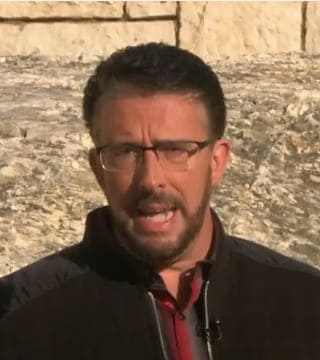
Standing in an ancient Jewish tomb on Mount Scopus overlooking Jerusalem, Perry Stone explores the biblical truth of resurrection from Daniel 12:2, where those sleeping in the dust will awake—some to everlasting life, others to shame and contempt. He vividly describes first-century burial practices, including the use of spices, linen wrappings, and ossuaries, to illustrate how Jesus' body was preserved from corruption, fulfilling Messianic prophecy. Ultimately, he emphasizes that death separates the spirit from the body, leading to immediate conscious destinations in Paradise or hell, and calls viewers to accept Christ for the resurrection unto eternal life, when the dust will sing in glory.
From Mount Scopus in Jerusalem
Welcome to the Manna-fest telecast right here on Mount Scopus in the city of Jerusalem. Mount Scopus is on the east side of the eastern wall of the old city of Jerusalem, and it is part of a chain of mountains that connects to the Mount of Olives. Of course, it’s one large chain, but the mountains have different names.
The Mount of Olives, in fact, is directly in front of me. From where I’m standing, I can see the Church of the Ascension, the traditional site where Jesus was taken to heaven in Acts chapter one. Now I’m in a unique place because this is the first time we’ve ever taped a telecast in something that looks like this. I’m standing in an old burial site.
An Ancient Burial Site
This is where the dead were buried back in Roman times, or back in the time of Jesus. I’d like to take you, however, to the Book of Daniel and share with you a message today that’s on my heart, called «When Dust Shall Sing.» It’s in Daniel chapter 12; here’s what the verse says: «Many of them that sleep in the dust of the earth shall awake, some to everlasting life, and some to shame and everlasting contempt.»
Now, that word «contempt» in Daniel 12:2 is a Hebrew word that means to be abhorred, to be rejected. In Isaiah 66:24, there’s an odd verse that says, «They shall go forth and look upon the carcasses of the men that have transgressed against me; for their worms shall not die, neither shall their fire be quenched, and they shall be an abhorrence unto all flesh.»
Two Resurrections Foretold
That’s the same type of Hebrew word in Isaiah 66 that is used here in Daniel 12. So when it says that there will be a resurrection of the righteous, some who are resurrected that are righteous—in fact, all that are resurrected in the righteous resurrection—will go into everlasting life. But there will be another group that will go into everlasting shame, and that would be the group that would be separated from God in a compartment called hell, which is, biblically, if you look at all the references and consider even the scientific evidence, a huge chamber located somewhere underneath the Earth.
What I want to concentrate on is this: I want to focus on the burial practices from Jesus’s day. If you look at the New Testament, you’ll discover that Jesus made several references to whitewashed tombs. He said on one occasion that the Pharisees were whitewashed tombs, full of dead men’s bones.
Whitewashed Tombs Explained
What he was referring to is where I am right now—one of these particular burial places—and this one does date back to that timeframe. In that day, this would have been a building; in other words, there would have been an entrance. You can see the door here; there would have been a very large rolling stone over this door.
Once you come inside, I’m going to show you what they did. You have a series of niches where the body would be wrapped up and placed. I’ll tell you what they did in a moment, and this is what Jesus was talking about when he talked about a whitewashed tomb. All of these are cut out of limestone; the limestone is always white in color, so that’s where you get the reference to Jesus about being whitewashed but full of dead men’s bones. That’s exactly what this was; it was simply a burial place where the dead were interred.
Preparation of Jesus' Body
In the story of Jesus Christ in the book of St. John’s gospel, a man by the name of Nicodemus, who was a member of the Jewish Sanhedrin, took the body of Jesus. The Bible tells us that he brought 100 pounds of aloes and myrrh and wrapped the body of Jesus in linen. I’ve always questioned why he did this, and I do believe that Nicodemus—though we do know he was a secret follower of Jesus—did something significant by what he purchased. I want to explain it to you.
In the story of Lazarus, you remember when Jesus raised Lazarus from the dead? He told them to remove the stone; that would have been this stone right here, the big rolling stone. Lazarus would have been placed in a niche just like this, and then Jesus raised him from the dead and said, «Loose him and let him go, ” meaning „unwrap him from all of the linen that he is wrapped in.“
Burial Without Embalming
See, Jesus could raise Lazarus from the dead, but Lazarus could not undo the wrappings around him; he was tied up like an Egyptian mummy. The men with him, who saw the resurrection, had to unwrap him. Remember, they said Jesus waited four days to raise Lazarus, and it said, „By now he stinketh.“ In other words, they did not embalm bodies in the time of Jesus; when you died, you were usually buried that day.
That’s how the Orthodox Jews do it in Jerusalem. When someone dies at 11 in the morning, they prepare the body and bury him before sunset. So, Lazarus was buried with his blood still in his body. Now Jesus, on the other hand, had no blood in His body, and this is what it means.
Preservation from Corruption
It means that by having no blood in His body, the body would have preserved a little bit better than Lazarus’s body would have. However, the aloes and the myrrh that were smeared on the body of Jesus—now don’t miss this—helped preserve the body, so the body of Jesus did not go through the corruption state that a normal dead body would have gone through: number one, because there was no blood in His body, and number two, because of the aloes and the myrrh and the tight wrappings of the linen.
Now, that’s interesting because in the Book of Psalms there’s a prophecy, and also in the book of Acts, and it says, „Thou shalt not leave his soul in hell, neither will you suffer your Holy One to see corruption.“ That is a Messianic prophecy about the Messiah’s resurrection; His body did not corrupt.
Proof of the Resurrection
Here’s the reason why: God wanted to raise Jesus up from the dead and allow Him to have a body with the scars on it, so that men and women would know that it was really the Christ; number two, that He really suffered; and number three, that it was really He who was raised from the dead and not just someone who looked like Him.
Now, here’s what they would do in the time of Jesus. They would bring the body in here. Now, this is a stone table; this is actually authentic and original from that day. They would lay the body on this stone table where I’m standing right here, and they would wash the body completely—wash the body down.
First-Century Burial Process
Here is where they would put the spices on the body; here is where they would wrap it, and then they would place the body in one of these niches. Now, there’s one here, two, three, four, five. There’s a big one here, six, seven, eight, nine, ten, eleven. Now, there are eleven of these all in this area.
This niche here was for an oil lamp; when you came in and it was dark, you would put your oil lamps in these niches and light them so you could see. So they’d wash the body, wrap it up, and stick it in one of these niches.
Secondary Burial in Ossuaries
Now, here’s the catch; this is really important for you to understand. A year later, a year after the death, the family would come back into this area and they would pull the body out. Why? Because by that time, the body and the flesh had deteriorated and all that was left was bones.
They would then lay the body back out on this stone table inside the burial site a year later. Now, the reason they did it on the inside and not on the outside is that if they were doing this on the outside, they would be considered ceremonially unclean. But by doing it on the inside, everything here was considered unclean ceremonially, according to Jewish law, because you couldn’t touch a dead carcass without becoming unclean. So they would come on the inside.
Ossuary Bone Boxes
Now, when they unwrap the linen, they would take the bones apart and wash the bones with wine and oil. Then they built a box—I’ll show you a picture of one of these; it’s called an ossuary. The ossuary box was a box that was usually cut out of stone, and they would sometimes put the name of the person and a brief account of significant deeds.
They would put those bones in the box; it was actually a bone box, then they would place the box back in the niche. In reality, after a period of time, you could actually—I would estimate, having seen bone boxes—you could put one, maybe two, in each of these niches. But in the larger ones, archaeologists will discover four, five, and six of these in a niche, like the mother, the father, and the three kids. So these were very well known in the time of Jesus.
Let the Dead Bury the Dead
One of the most intriguing verses in the Bible is found in Luke chapter 9, verse 60. I want to give this to you. When I was working on my study Bible—by the way, it’s not ready; it’s still going to be a couple of years—but just so you know, we did work on it.
In Luke’s gospel, there was a young man that came to Jesus who made this statement: „Lord, I would like to follow you, but let me go bury my father.“ Jesus looked at this young man and said, „Let the dead bury the dead.“ Now, if you’re reading this from a western perspective, here’s what you’re thinking: this poor boy’s dad has just died, and he wants to go to the funeral, and Jesus is rebuking him for going to the funeral and saying, „Forget about your dead father and follow me!“ That is really not what’s happening there.
Understanding Jewish Custom
First of all, if the young boy’s dad had died, let’s say that day, he would not even be with Christ; he would be required, as a Jew, to be at the funeral helping to bury the father. It’s a requirement. Why is he following Jesus and now saying, „Let me go bury my father?“
I told you a moment ago, this is the key to the story: it was a year later, and he would have had to go back, or the family would have had to go back into this burial site and pull the body out and lay the father’s body out, and then take the bones and put the bones in the box. So, it was a year after the original death of a person that this process took place.
Jesus' Call to Follow
What Jesus was actually saying was this: He was not rebuking the boy for going to his father’s funeral. It was normal to go to funerals; Mary and Martha went to Lazarus’s burial; they wept there, no doubt. But He was saying, „Your father has been gone a year; let the people who deal with burying the dead and taking care of the dead handle that. It’s time for you to get about the king’s business and follow me.“
I found this fascinating about two years ago when I started researching this because I was getting a little upset at Jesus telling some boy not to go to his dad’s funeral, but that’s really not what was taking place if you understand the context of a burial site, etc.
Tombs Around Jerusalem
Now, these tombs have been found outside the city walls, and one of the tombs that was discovered several years ago was called the Tomb of Caiaphas the Priest. It was discovered on the Mount of Evil Counsel. In fact, we were in a tour bus, and they had hit a tomb like this with the tour bus, and we had no clue until years later when they published the article.
We were there the day the bulldozer hit the door of the Tomb of Caiaphas the High Priest. Most of the archaeologists who researched this believe it is indeed in this area of Jerusalem as well, on the Mount of Evil Counsel, which is directly in front of me, behind the camera where you’re watching on the screen.
The Reality of Death
But let’s talk about death for a moment. It’s a subject people don’t like to discuss until they have to. In the Book of Genesis, the first mention of death is where God warned Adam not to eat of a certain tree—the tree of the knowledge of good and evil—for „in the day that you eat thereof, you shall die.“ The word „die“ is first mentioned in the Book of Genesis.
Now, here’s what’s interesting, and this has been pointed out to me for quite some time: Adam did not immediately die when Eve and he ate from the Tree of the Knowledge of Good and Evil. So, did God lie? Because God said, „The day you eat thereof, you will die.“ No, God cannot lie according to the Book of Numbers.
Spiritual Death First
Here’s what happened: when they ate of the Tree of Life, they died spiritually. The Bible says in 1 Thessalonians 5:23 that you are a body, you are a soul, and you are a spirit. So, what happened to them is when they disobeyed God, they first died spiritually on the inside; they became separated from God.
God used to come down at the Tree of Life at the cool of the day in fellowship with them. God ceased from doing that totally and completely, so they died spiritually. Now, we do not know how old Adam was; he was created as a full-grown man. Jewish rabbis estimate that he would have looked at least 30 years of age because that number is quite extensive in the Bible—possibly even 20 when God created him.
A Thousand Years as One Day
But we do know that when he died, he died at age 930, which means that he died a very old man. But he died spiritually first and physically later. Now, I want to give you a nugget; I’m just going to throw this out here. The Bible says in the Book of Psalms that one day with the Lord is as a thousand years, and a thousand years is as one day.
If a thousand years is one day in God’s sight and Adam died at 930, he died 70 years short of one thousand years—which would be one day in the eyes of God. God said, „In the day that you eat it, you will die.“ I’m not going to make a theology out of that, but I think that’s very interesting when you consider putting that together.
Body, Soul, and Spirit
Now, I said a moment ago that you are a body, a soul, and a spirit. So, what happens when you die? Well, the scripture tells us that death is actually separation; it’s a separation of the soul and spirit from the physical body. 1 Thessalonians 5:23 and other references in Daniel support this.
You are the body; that’s your flesh—that part that when you pinch, you can feel it. You put your hand on the fire; you can feel it. You put your hand in the refrigerator; you can feel the cold. That’s the body. Now the soul is connected to the intellect, the mind, the emotions, and the will.
The Eternal Spirit
The spirit, or the spirit man, is the part of you that lives on the inside of you that looks like you. If it came out of your body, your loved ones would recognize you. Now, for some reason, the spirit does not age and wrinkle and get sick the way that the physical body does. Once you grow to a certain level physically, your spirit man grows to that level, and that’s what you look like.
Now, what is death? Death is the separation of the soul from the spirit. Now, there are two major teachings about what happens at death. I have some very good friends of mine, and by the way, they are godly people and wonderful people, but they have a slightly different belief about what happens at death than I would have.
Soul Sleep Doctrine
There’s a doctrine called soul sleep. Soul sleep basically goes throughout the Bible, and in the Book of Daniel, it says those that sleep in the dust will arise. Paul talked about those which are asleep in Christ. As a matter of fact, Jesus even mentions this in Mark 9:24. When a girl had died, he said, „She is sleeping.“
In the story of Lazarus in John 11:11, Jesus said, „My friend Lazarus is sleeping, ” and the disciples thought that Jesus meant he was taking a long nap because he hadn’t been feeling good, but in reality, Lazarus had died. Because in the Bible, or in the New Testament as well, the word „sleep“ is used concerning death, I have some very good friends of mine who teach what’s called soul sleep, which states that the moment you die, the soul and spirit remain in the body, and wherever that person is buried, the soul and spirit sleeps.
Sleep as Metaphor
In other words, the people have no consciousness; they just lie there just like they’re sleeping—just like you’re in a deep sleep with no knowledge. Then, at the resurrection, they are awakened to new life through the resurrection and given a brand new resurrected body. Now, personally, I believe from studying this in detail that the word „sleep“ there is a metaphor because when a person has died, they look like they are sleeping.
In fact, in classical Greek, there’s a story of soldiers who had died, and it says they were sleeping the sleep of death. So in Paul’s day among the Greeks, the word „sleep“ was used as a metaphor—not with the soul and spirit sleeping in the body, but as a metaphor for death in general.
Giving Up the Spirit
So that’s one point I’d like to make. The other point I’d like to make is this: when you go—and I’ll give you the references here—Abraham, in Genesis 25:8, when he died, it says he gave up the ghost. Then we read where Isaac, in Genesis 35:29, died and gave up the ghost. Then we read in Mark 15:37 that when Jesus died, he gave up the ghost.
Now, the word „ghost“ is an Old King James 1611 language. The newer translations translate it correctly: and he gave up his spirit. He gave up his spirit. He gave up his spirit. What does it mean to give up your spirit? It means that your soul and spirit are released out of your body.
Immediate Destination After Death
Now, this doesn’t just happen to righteous people; this happens to sinners when they die. Let me give you two examples: you find in Acts chapter 5 that when Ananias and Sapphira died and lied to the Holy Spirit—meaning they died unrighteous—they gave up their spirit, or gave up the ghost, as the 1611 translation says. You will also discover that there are other references, like when Herod died, in the book of Acts. It says he gave up the ghost, meaning he released his spirit.
Now, what happened at that point is that the soul and spirit can only go to two locations. There is not—I’m stating this from the biblical perspective—there is not a place called Limbo. There’s a teaching called Limbo that says that especially the spirits of infants or whatever—that haven’t sinned—go to a limbo state where they wait until God calls them into the kingdom or whatever He chooses to do.
No Purgatory in Scripture
There’s also—and I realize this is a controversial subject—because, you know, the background of my mother’s family is from Italy, so you all know what particular religious group they’re from. Their background is rooted there. But there is a teaching of purgatory, which became a church tradition, but as far as what the Bible teaches, I’m going to stick strictly to the Bible.
There’s no teaching of purgatory, meaning that a person who dies with certain types of sins has to go through a fire somewhere beneath the Earth and then God—the people who are living—can pray them out. I’ll be honest with you; I wish that were a true teaching because there are people that have passed away that I’d love to be able to pray out. But the Bible teaches that once a person is there, they remain there.
The Rich Man and Lazarus
A good example is found in Luke chapter 16. When the rich man died, he lifted up his eyes in hell, and he even begged Abraham; he could see Abraham in another chamber. There was a lower chamber of hell and an upper chamber called Abraham’s bosom. He said, „Go send someone, for I have five brothers; go warn them not to come to this place.“
So, in other words, let me say this: once the spirit has left the body and has gone to its eternal abode—whether it’s everlasting life or everlasting damnation—there is no way in scripture of pulling that spirit back into changing locations, let me say it that way.
Paradise and the Resurrection
In other words, in 2 Corinthians 12, when a believer dies, the Bible talks about Paradise, located in the third heaven. They will be taken into Paradise where they will wait for the resurrection of the dead. If a person dies unrighteous, their soul and spirit go into a lower compartment called hell. But they too are going to be resurrected and will stand at a judgment called the Great White Throne Judgment, and then there is something called the Lake of Fire, where those individuals are placed.
I know it’s not a popular teaching; in fact, some people won’t even touch on the subject. But there’s one thing about it: that is this. One of the things that will help you to serve God and to live right is to know where you’re going.
Motivation for Holy Living
If you know you’re going to heaven and you don’t want to risk that, you’ll do your best to keep a repentant spirit, follow the Lord, and do the right thing. If you do believe there’s a hell, you’ll do the same thing; you’ll do everything you can through following the word of God and living according to the covenant to avoid going to that place.
Now, one thing I want to say is that the souls and spirits of righteous men and women are now in the third heaven in a place called Paradise. In 1 Thessalonians 4, where Paul gave the revelation of the coming of the Lord for the church, Paul said that those who are with Christ he will bring with him when he returns for those of us who are living, meaning the dead in Christ.
When Dust Shall Sing
The Bible says the dead in Christ shall rise first. There’s a physical body—the DNA of the dust on the earth—that Jesus will somehow put back together. All it takes is one speck of DNA. If there are any bones that ever rotted in this tomb, all it takes is one speck of DNA to recreate that person. That’s a fact; even science talks about that.
So the dust shall be raised again with a brand new resurrected body. It will be a glorified body. However, the Bible says that he will bring them with him—those are the souls and spirits—that’s in 1 Thessalonians 4, that Christ will bring with him. And there will be a day, ladies and gentlemen, when dust will sing.
Call to Salvation
Daniel chapter 12: I pray that you will be in the resurrection of the righteous. I pray that you accept Jesus Christ as Lord and Savior, that you enter into a covenant with Him, and you say, „Jesus, I’m a sinner; come into my heart and my life.“ Because if you will serve Him, get into His word, and love Him with all of your heart, then the resurrection you will be in is the one in Daniel 12 that leads to everlasting life.
I wish I had time to share with you about the various resurrections that are going to take place: the resurrection of the dead in Christ, the resurrection of people who are martyred in the tribulation, the resurrection of sinners at the end of the 1,000-year reign. There’s a specific order of resurrections according to 1 Corinthians chapter 15.
So today on Manna-fest, I wanted to share this word with you from Mount Scopus in Jerusalem, and I have something special, as you know, a great offer for our Manna-fest audience. I’ll be right back; stay with me.