
Perry Stone - The Jubilee Revelation (01/07/2026)
Summary:
Preaching from Nazareth, the preacher explains Jesus' first public sermon in Luke 4, where He quotes Isaiah 61 to proclaim «the acceptable year of the Lord» as the Jubilee—a time of freedom, rest, and restoration. By stopping short of the «day of vengeance,» Jesus announces Himself as the fulfillment of Jubilee, bringing spiritual liberation, healing, and wholeness to believers now, rather than future judgment. He ties this to the sabbatical and Jubilee cycles in Leviticus, showing Christ as our ultimate rest and deliverer from oppression, sin, and brokenness.
Taping from Nazareth
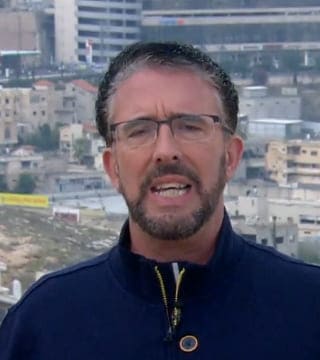
You know this is going to be a very exciting program. Uh, we’re taping in a location that we have never, in 14 years, taped on a Manifest telecast. Only because when we’re on our tour, we’re usually traveling directly from Galilee to Megiddo or Megiddo to Galilee, and we don’t always have the time to stop and make a tape.
Look here, this is where the Pope spoke when he was in the Holy Land some time back. 40,000 Christians from the Holy Land and pilgrims from around the world gathered here. This is the city of Nazareth.
Now I’m going to point out something in a moment from a sermon that Jesus preached. His first public message was preached in this city. But I want to tell you something: it was not a city the size of what you’re seeing now.
The Historical Nazareth
As a matter of fact, you can see a hill that is right in the middle of this beautiful community of Nazareth. In the Bible, it tells us that the city was built near the edge of a hill, and Jesus preached a message that made people so mad they tried to push him off the cliff and actually kill him.
We don’t know exactly; they have a tradition as to where the city was located. There is a building; you can see it in the distance. Here’s a church. They say there was a well there. There is a spring of water there; they call it Mary’s well.
Somehow, it was built on that area up there because an old synagogue was discovered. But what I want to key in on today is the sermon Jesus preached, and I’m going to talk about a word called Jubilee.
My good friend Jonathan Cahn has written a book that deals a little bit with what is called the Shemitah, and we’re not going to talk about that or minister to that, but I’ll be bringing it out in just a moment in this message about that particular year and what it means.
Jesus' Sermon in Luke 4
The thing I want to emphasize, though, is the Jubilee cycle as it relates to Jesus’ ministry and what that means to you and me.
Now here’s what the Bible says. We’re going to go to Luke chapter 4. For those of you that may follow me, you know in churches I used to say, «Open your Bible.» Now it’s, «Go to your pod, go to your phone and get the scripture.»
But here’s what the scripture says: in Luke chapter 4, Jesus is in the area near Jericho in the Judean Wilderness, and he’s being baptized by his cousin John at the Jordan River. Now, he spends 40 days in that area, and during that time, we know that the mountain of temptation above Jericho is not too far.
I think they told me if you walk it straight, it would be about 18 to 20 miles to the Temple Mount. We know Satan took Jesus to the Temple Mount area and told him to cast himself down from the pinnacle of the temple and that the angels would supernaturally protect him.
Of course, Jesus did not fall into any of the temptations of Satan because the Bible tells us that he was tempted in all points, as you and I, yet without sin.
Now, after he fasted, we don’t know what the scripture says about where he ate because after the 40 days he ate somewhere. I’m assuming it would have probably been somewhere outside of Jericho or that region because he wouldn’t have come all the way here, which would have taken days to have gotten here back in his day if he was walking or something of that nature.
So we find out that then he comes to Nazareth, which is his hometown.
Nazareth in Jesus' Time
Now Nazareth back in that day, just take all of the buildings away. Take all the buildings that you see, and just remove them if you can do that in your imagination, and put just a city here with probably, are you ready for this, 30 to 50 families? That’s how small and insignificant it was.
Can you remember when one of the disciples went to his brother and said, «I have met the Messiah?» Where did he come from? He came from Nazareth. Remember the response of what that brother said? «Can any good thing come out of Nazareth?»
Why would he say that? Well, first of all, it was in upper Galilee, and the Galilee, of course, is called the Galilee of the Gentiles, so it wasn’t a predominantly… it was very much a Gentile-controlled area.
But the second reason is the size of it. You know if God’s going to send the Messiah, come on folks, he’s going to have to send him from Jerusalem somewhere near the Temple Mount.
But no, God chooses the insignificant places to do His great work. He chose a simple town called Nazareth; he chose a small town called Bethlehem where the Messiah was born. Nazareth where he was raised.
He gave him the name Yeshua, which in Hebrew is a form of Joshua, a common name back then. He allowed him to be born and laid in a manger, which was a common feeding trough for animals. He had to borrow a boat in order to cross the lake at the Sea of Galilee and was even buried in a borrowed man’s tomb.
You know it’s okay to borrow the tomb; Joseph of Arimathea knew, «Let him have my tomb; he’ll be up in a few days and I’ll get it back.»
The point is Jesus came to the common people, to the common part of the land, to minister to the average everyday person. He didn’t come to minister to the aristocrats; he didn’t come to minister to those who were already religious because he said, «I come to the lost sheep of the House of Israel.»
And that should mean something to you because what it means is that no matter what level you’re at spiritually or emotionally, what level you are in any area of your walk, he comes to minister to the lowest, all the way, someone said, «from the uppermost to the guttermost, ” and that’s how he came to minister to all men.
The Significance of Nazareth
Now I want to take you here again because I want to show you what’s happening in that day. There was a well of water here and if you came through Nazareth, you only came through Nazareth to get a drink from the water, and that’s significant because Bethlehem means „House of Bread.“
Nazareth was a place where there was water, and Jesus said he’s the living water, and he says, „I’m the bread come down from heaven.“ So how neat is it that the place he was born was the House of Bread, and the place where he was raised, the only main thing here that was worth coming for was to get a drink of water—a drink of water from the well.
But I’m getting sidetracked here a little bit. You all have to bear with me because when I get over here, I go on all kinds of rabbit trails. I can’t hardly stay on my subject.
But Jesus comes to Nazareth, and he goes into that synagogue where he was raised.
Now remember this—it’s a small town; they watched him grow up. We know he lived here after Herod tried to kill the babies of Bethlehem. Joseph, Mary, and Jesus, along with some other families, according to tradition, went down to Egypt.
The Bible tells us that, but when they came back, they were going to live in Bethlehem, and the angel said, „Don’t live here; you’ve got to go back in the Galilee.“ So they came to Mary’s hometown here at Nazareth.
Now again, small town, so everybody knew Jesus. They knew him growing up. He never performed miracles growing up.
Now, I do know that there are some church traditions that emerged many years after the resurrection of Christ about Jesus creating clay birds. This boy ran into Jesus, and he got mad at him, and the boy dropped dead. Mary made him raise him from the dead again.
Those are traditions; those are not actual narratives that happened because your Bible says that the first miracle Jesus did was in Cana of Galilee. The first miracle was in Cana at 30 years of age.
So between 12 years of age and 30 years of age, we have no biblical record of Jesus performing a direct miracle. Those would just be based on traditions or stories that were handed down that really are not based on scripture.
But let’s go to scripture.
Jesus Reads from Isaiah
So Jesus goes into that synagogue, right, and he gets ready to preach this message. And let’s read it.
Jesus returned in the power of the Spirit into Galilee, and there went out a fame of him through all the region round about, and he taught in their synagogues, being glorified of all.
He came to Nazareth where he had been brought up, and as his custom was, he went in the synagogue on the Sabbath day and stood up for to read.
Now again, this is the synagogue where he was raised as a young boy for, we would estimate if we look at the biblical timing, probably about 25 years or so.
And there was delivered unto him the book of the prophet Isaiah, and when he had opened the book, he found the place where it’s written.
Now Isaiah is on a very large scroll, and you have to turn the scroll to find the place where to read. This tells me Jesus was very familiar with the scripture, very familiar with what it said.
So he finds this place; now I’m going to read to you what’s going to come on the screen, which is a passage of scripture found in Isaiah chapter 61.
Now this is what Jesus preached that day at Nazareth: „The spirit of the Lord is upon me, because he hath anointed me to preach the gospel to the poor. He has sent me to heal the brokenhearted, to preach deliverance to the captives, the recovering of sight to the blind, to set at liberty them that are bruised, to preach the acceptable year of the Lord.“
Now in my Bible there’s a period there at verse 19, which you see that on the screen. Now verse 20 picks up and says this: „And he closed the book and gave it again to the minister and sat down, and the eyes of all them that were in the synagogue were fastened upon him.“
Then he said—and this is what really got them stirred up—then he said, „This day, this day is this scripture fulfilled in your ears.“
This day is this scripture fulfilled in your ears.
Now if you keep reading the story, when Jesus began to teach from this, saying, „Now today this is fulfilled, ” he really starts stirring up—I’m talking about in a major way—everybody in the synagogue, to the point that they wanted to kill him.
So they ran him out of the synagogue, as we said earlier, to the edge of the city and tried to throw him off the cliff. But supernaturally, God protected him because the Bible said he then passing through the midst of them went his way. So Jesus was spared here in his own hometown.
Now the bottom line about Nazareth was that the scripture says that he could do no mighty works in Nazareth because of their unbelief.
This is one of those places. I think one of the other translations—or a minister said one of the other translations—could read, „There he could do no significant miracles; he could do no great miracles, save that he healed a few sick folk—just minor ailments.“
In other words, people with minor ailments, nothing great. And it was because of the unbelief of this city; because they saw him growing up, they said, „Who does he think he is?“ Even though he’s doing miracles.
The Acceptable Year of the Lord
Now here’s the point I want to make in Luke chapter 4. Jesus is quoting from Isaiah 61:1-3, and in verse 18, I use traditionally the King James translation when I ministered because that’s what I learned to quote as a young preacher when I was 16, 18, 20, 25 years of age.
But the point I want to show you is in verse 19. Jesus says, „To preach the acceptable year of the Lord, ” and there’s a period placed in our Bible correctly because he stops his thought.
If you were to go to Isaiah chapter 61, where this particular verse is quoted, and look at the verse, I’m going to read this to you again. This is the authorized King James translation: „The spirit of the Lord is upon me because he has anointed me to preach the good tidings to the meek. He has sent me to bind up the brokenhearted, to proclaim liberty to the captives, and the opening of the prison to them that are bound.“
Now that’s very much what we read in the New Testament translation: „To proclaim the acceptable year of the Lord and the day of vengeance of our God, to comfort all that mourn.“
Now if you look at this very carefully, Jesus did not quote all of the passage; he cut it in half. He just stopped it short because here are the two themes of verse two: I’m coming to bring you an acceptable year of the Lord and I’m coming to bring you vengeance from the day of our God.
You have to understand what the term „acceptable year of the Lord“ means and understand what the phrase „vengeance“ means as it relates to the prophets of the Old Testament and as it relates to the Torah, which are the five books of Moses.
Let’s start with the day of vengeance. In the Old Testament, there’s a word „vengeance“ which is used extensively in different scriptures: „the day of vengeance, ” „the vengeance of our God, ” etc. „Vengeance is mine, saith the Lord; I shall repay.“
In the setting of the word „vengeance“ among certain prophets, they are dealing with the Great Tribulation which has not yet happened, which is coming in the future—the day of God’s wrath, the day of God’s judgment and the day of vengeance.
Now if the day of vengeance was something which was going to happen in the future, because let’s say when Jesus preached this message, you know it’s been well over 1900 years to where we are today—well over 1900 years—you know, and so if Jesus was coming to bring vengeance to the people, he would have completed that statement and said, „And I’ve also come to bring vengeance.“
He knew that vengeance is not why he came the first time.
Remember this: the vengeance side of God is connected to Jesus being the Lion of Judah. A lion has authority; a lion has power. He’s introduced as Christ in the book of Revelation as the Lion of the tribe of Judah when he’s about to open the seven-seal book and introduce judgments upon the Earth during the tribulation.
Now he came the first time as the Lamb, and the Lamb came to shed his blood to bring the word „redemption.“ Redemption is to redeem a person out of something. In our case, it was Jesus redeeming us out of the hand of the devil, out of the hand of the enemy.
Now that’s the vengeance part of Isaiah 61. And right around there, I said verse three earlier, it’s actually verse two.
The Jubilee Explained
All right, what does it mean, „the acceptable year of the Lord?“ The acceptable year of the Lord in our Bible is a phrase that would have been known to the Jewish audience, and that phrase is called „the Yoel year, ” the Year of the blasting of a chofar for the Year of Jubilee.
The Year of Jubilee—let me talk to you about this for just a little bit. First of all, there were what’s called sabbatical cycles.
The first sabbatical cycle God established was the Sabbath day, in which every seventh day people were to cease from labor and to rest.
The second sabbatical cycle was every seven years. Now this is called the Shemitah, and the Shemitah is when every seven years you let the land rest. You let the animals rest, and you do no work.
So what God would do is on the sixth year, he would supernaturally give you such an increase of fruits and vegetables and farming on the land that you could live on the seventh year without ever having to plow.
Hey, American people would vote a guy in that says, „Hey, every seventh year there’s no work.“ You know what I’m saying? And you know, live off the government or whatever; they’d say, „Oh yeah, put him in!“ You know, but this was actually something that was established by the Lord; every seventh year.
Now what they would do is they would count cycles of seven years. Let’s say I’m born—okay? I’m born, let’s say, on a Jubilee year. Well, if I live to be 60, I get another Jubilee.
Here’s how it goes: I’m seven years old; the seventh year is your Shemitah year. I’m 14 years old; that’s my second Shemitah year. I’m 21 years old; that’s my third Shemitah year. I’m 28 years old—are you with me? And now I go seven years. That means I would be 49 years of age, but in your Bible it’s called the Jubilee in the Book of Leviticus chapter 25.
And on the Jubilee year, the silver trumpets would sound on the 10th day. It would be the uh seventh month, the 10th day, which was the day of atonement.
And when those trumpets would sound on that day of atonement, what would happen is that there would be this freedom declared among the people. If you were a Hebrew slave, you were permitted to go back to your family.
If you had lost your property because of a terrible business or someone had bought it, and you lost your property, you would be able to redeem your property back on the Jubilee year as long as you could provide a will that proved that it belonged to your family.
And the Bible says you’re not to oppress one another on the Jubilee year.
So this is a fascinating thing because if you look at it very carefully, the Jubilee was something every Hebrew looked forward to.
They looked forward to Sabbath because they could say, „Wow! Hey, it’s Sabbath again! I don’t have to work; I don’t have to go milk the cow; I don’t have to go out…“
You know, I heard one guy preaching saying this funny he said, „And I don’t have to go out and feed the pigs.“ I said, „Oh, he missed that message badly because a Jew doesn’t touch pigs, okay? Just so you’ll know, they didn’t feed pigs back then, ” but anyway, he kind of messed up his message. That wasn’t me, by the way; I just want you to know.
But anyway, they… but then every seventh year was another whole year of rest.
As a matter of fact, let me tell you how God looked at people resting and making sure that they kept their life stress-free. Did you know, now for all you young people out there, this was under the law of God, and someone says, „Woo, let’s go back under that because if you were to get married, you and your”—let’s say it’s a guy and he marries a woman—the bride and the groom took a year off from work.
You did not have to work for an entire year because God said, „I want you to get to know each other.“
And listen, if you were to go to war and war was breaking out, and you got married, you could exempt yourself from war because God did not want somebody just to get married, not have children, and not be able to carry on the name of the husband—or the father’s name, we would say, of the children.
And so God said you can exempt yourself from war. I guarantee you one thing: there were some guys that if war was breaking out in Israel, they were going to go get themselves a wife because they didn’t want to fight in that battle.
These are some of the very unusual and practical things God established.
Jesus as Jubilee
Now let’s go back to this. Jesus says I’m come to preach the acceptable year of the Lord, meaning I’ve come to bring the Jubilee.
Now here’s the part that I want to bring out: the Jubilee was not a year when Jesus came to introduce the acceptable year of the Lord.
In his preaching of Luke chapter 4, he was saying, „I am now your Shemitah. I am now your Jubilee. I am now your rest.“
Now here’s how this works for you who have known Jesus and you’ve accepted Christ into your heart, whether anywhere you are in the world. You know how that true faith in the Lord and the power of His Spirit and his anointing breaks yokes in your life.
There was a time that some of you—if we would go back to the days before you knew the Lord—you didn’t sleep well; you were restless all the time; you were depressed; you were oppressed; you lived in fear; you lived in anxiety; you lived in unbelief.
And then you found the Lord, and when you found the Lord, you found not only the Shemitah, which is the internal rest of your soul, your mind, and your spirit, where now you lay down on the bed at night and you don’t worry; you cast your cares on the Lord.
And so you don’t have to be frustrated all the time, and you can just live in peace, righteousness, peace, and joy in the Holy Ghost, based on Romans, are the three things that represent the kingdom of God.
Let me say it again: righteousness, peace, and joy in the Holy Ghost. And so when you are living in this rest with the Lord, you experience that.
But the Jubilee is Christ. What does it mean that the Jubilee is now Jesus? It’s not a year, but it’s in Christ.
Because here, listen to what he said: „The spirit of the Lord is upon me because he has anointed me to preach the gospel to the poor.“ It’s freedom for poor people „to preach the gospel to the poor, deliverance to the captives, the recovering of sight to the blind, to set at liberty them that are bruised.“
These are things that people go through: spiritual blindness, oppression, fear, depression—all these things that Jesus speaks of in Luke—all these things he now says, „But believe on me and I can liberate you from your fear. Jesus says believe on me, and I can liberate you from your unbelief. Believe on me, and I can liberate you that are in prison.“
When you’re spiritually bound, you know it can be addictions or it could just be a number of things. But it says, „If you’re bound by these things, I am the one who can now liberate you. If you believe on the Lord Jesus Christ, you shall be saved.“
But I want to tell you something about the word „saved.“ The Greek word „sōzō“ is often translated in the New Testament, in English it will say „saved.“
But „sōzō“ is a Greek word that is used for the word „saved.“ Now when I say to you „you can be saved, ” most Christians think of one thing: they think of repenting of their sins and Jesus coming in their heart. Praise God, I’m saved!
Did you know the Greek word does not just mean to be saved from sin? It means to be made whole. It means for your mind to be whole; it means for your spirit and soul and body to be complete. Jesus wants to make you whole.
But he’s able to do it through the Jubilee.
I guess that’s how you spell that—is the Jubilee. I made a shirt one time and spelled it the King James way with the extra „e, ” and people said, „You spelled it wrong.“ And oh no, and I spelled it with one, it was, and it looked like the Jubilee.
But nonetheless, in fact, I’ve got to tell you something funny in closing: there are about 15 words I misspell to this day, and I kept saying, „Why do I misspell?“ Because I spell according to the King James Bible. I’m telling you the truth!
I spell „favor“ and I add a „u“ to it all the time. So I found out that when I misspell words, it’s because I read the Bible so much as a kid—I started spelling the 1611 English—and there are still about five of those words I have trouble with. Thank God for spell check on a computer!
But I wanted to throw that out there as well. But my point from here at Nazareth is you can be free from the powers of the enemy, and you can be liberated from all the powers of darkness.
So let me encourage you, if you’ve never accepted Jesus Christ as your Lord and Savior, he is your Jubilee. He came to set you free, and that’s why I’m here preaching this message at Nazareth from this hill where he lived.
God bless you! Watch the offer, and then please always stay with us till the end because there are always great things about to happen. Sometimes I’ve got some special things to share with you. I’ll be back in just a moment.