
Perry Stone - In The Beginning Was The End - Part 2 (01/06/2026)
Summary:
The preacher argues that the strongest proof of God’s existence is the precise fulfillment of biblical prophecy, where God declares the end from the beginning, as seen in Isaiah 48:3-5. Building on part one, he examines the seven feasts of Israel from Leviticus and Exodus, showing how Passover, First Fruits, and Pentecost were prophetic pictures fulfilled exactly in Christ’s crucifixion, resurrection, and the birth of the church. Ultimately, these patterns reveal God’s sovereignty, pointing skeptics to faith through undeniable prophetic parallels that no idol or chance could predict.
Proving God Through Prophecy
You know, someone asked me how I know that God is real. «You can’t see Him, ” they said. Well, you can feel Him! But that doesn’t help someone who never feels the Lord’s presence. I believe the answer is prophetic patterns, prophetic parallels, and the fulfillment of biblical prophecy.
Over the years, we have had so many people watch the Manna-fest program who were not believers; they were skeptics. As they would watch week after week after week and notice how great these patterns and parallels of prophecy are, God begins to open up the eyes of their understanding.
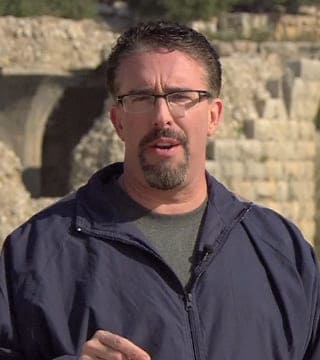
Last week on Manna-fest, I came to you from a place called Nimrod’s Castle. It was not built by Nimrod; it is actually a Crusader castle, and you can see the ruins directly behind me here. I did a teaching called „The Beginning Reveals the End: Part One.“ Today on Manna-fest, I’m going to be sharing with you „The Beginning Reveals the End: Part Two.“
Scriptures on Declaring the End from the Beginning
There are two scriptures that I want you to look at with me together. One is Isaiah 48:3: „I’ve declared the former things from the beginning; they went forth from my mouth, and I caused them to hear it. Suddenly I did them, and they came to pass.“
Isaiah 48:5 says, „Even from the beginning, I have declared it to you. Before it came to pass, I proclaimed it to you, lest you should say, ‘My idol has done them, ’ and ‘My carved image and my molten image have commanded them.’“
The point that God is making is this: in ancient Israel, there were people called Seers or wise men, or astrologers, who would look to different signs. Some of them would look to the heavens; some of them would believe, believe it or not, that they could read a calf’s liver. Others would look at the grains of coffee in the bottom of a cup, trying to make predictions about the future.
God said to Israel one time, „I’m going to prove to you I’m God because I’m going to predict some things that are so far out, that when they happen, you will know that I did it.“ Then God said to them, „Why don’t you look at your idol? Go ahead, consult your idol. See if your idol can tell you what your future is.“
So I’m going to say it again, and then we’re going to show you some things today that demonstrate how the beginning reveals the end. The Old Testament stories and accounts reveal things that are going to happen in the future. I’ll say it again: the way you prove God exists is by the fulfillment of biblical prophecy.
The Seven Feasts of Israel
Now, the seven feasts of Israel were established by the Lord from the time of the Exodus. God said to them there would be seven major appointed times each year. You know what they are: there is Passover, then you have Unleavened Bread, First Fruits, Pentecost, you have Trumpets, you have the Day of Atonement, and you have what’s called Tabernacles.
Now, I’m going to cover just very briefly three of these and show you how that particular feast had amazing parallels for the future.
Passover and Christ’s Crucifixion
The first one I want to look at is Passover. Passover occurred in Exodus 12, but the Passover story in Exodus 12 is a detailed account of one thing: the crucifixion of Jesus and our redemption. The list is going to come on the screen.
In the Exodus story, you had to take a lamb from the flock, and Jesus is called the Lamb of God. In Exodus, the lamb had to be without blemish, and the Bible says that Jesus was without sin. In Exodus, the blood was placed on the doorposts, and three crosses, or three wooden posts, were on Golgotha’s Hill when Christ was crucified.
The lamb had to be roasted on a pole, and Christ had to experience His death on the cross. The lamb had to be eaten to produce healing for the body, and Christ talked about eating His flesh and drinking His blood in John 6:54, which is communing with Him.
Then there was unleavened bread that was used at the time of the Exodus account. Why was that? Because Jesus had no leaven, or no sin, in Him at the time of His death. They also had to eat bitter herbs in the Exodus story. This parallels with them placing hyssop and vinegar, which is very bitter, to the mouth of Jesus on the cross.
The Bible tells us that the death angel was defeated by the blood of the lamb in Exodus, and death was defeated by Christ’s crucifixion and resurrection. The Exodus lamb, when they ate the lamb, brought redemption to all of them, and the Bible tells us that Jesus, the Lamb of God, purchased our redemption (Galatians 3:13).
Now that’s probably something that a lot of you who are mature in the Lord have already heard; you’ve heard the parallels of the Exodus account.
Feast of First Fruits and Resurrection
But let’s go to the next feast, which is, I should say, not the next one—that would be Unleavened Bread—but the Feast of First Fruits. Let us see if there are some unusual parallels in First Fruits.
Listen to Leviticus 23:10–13: „Speak to the children of Israel and say to them, ‘When you come into the land which I will give you and you shall reap the harvest thereof, then you shall bring a sheaf of the first fruits of your harvest to the priest. He shall wave the sheaf before the Lord, and be accepted for you. On the morrow after the Sabbath shall the priest wave it, and you shall offer that day when you shall wave the sheaf, a he lamb, that’s a male lamb, without blemish, of the first year, for a burnt offering unto the Lord.
And the meat offering thereof shall be two-tenths of fine flour mingled with oil, an offering made by fire unto the Lord for a sweet savor. And a drink offering thereof shall be of wine, the fourth part of a hin.’“
Now I want you to notice this, because what we’re going to show you is this: when God established the Feast of Tabernacles in the Old Testament, and He established the Feast of Trumpets, and the Passover, and Unleavened Bread, and Pentecost, all of these were going to be pictures of something that would relate to the Messiah. How does First Fruits relate to the Messiah?
Now, if you go back to Leviticus, I challenge you to do this after the program, Leviticus 23:10–13. If you go back to that, you will notice this: First Fruits had to be brought the morrow after the Sabbath. Now, the Sabbath day was on Saturday, so the day after the Sabbath would be on Sunday. So, on a Sunday, they brought the First Fruits to the temple.
Now, in Jesus' day, what happened was the priest would go out of the Eastern Gate, and there was a field there of barley. He would cut down the first-ripened part of the barley that had already been wrapped with a reed, or a red string. The red string was actually used on the fruit trees; this was a reed that wrapped around the part of the field that was first ripe. He would cut it down and take it to the temple.
As he took it to the temple to present the First Fruits to God, he would also offer a lamb without blemish the morrow after the Sabbath.
Jesus as First Fruits
Now someone may say, „What does that have to do with Jesus?“ Here’s what it has to do—now follow me carefully. If you read the story of the women who came to the tomb, Jesus had been crucified; three days had passed, which means Passover was finished, Unleavened Bread was finished, and now they were coming to the time of First Fruits.
Now the reason Paul says in the New Testament that Christ is the First Fruits of them that slept is that when Jesus is meeting Mary there at the Garden Tomb, and she looks at Him and realizes who He is after she hears His voice, He said, „Don’t touch me, ” or „touch me not, ” as the King James says. „Touch me not, ” the Greek says, „Do not delay me, for I’ve not yet ascended to my Father.“
Now Christ was on a mission in which He was about to go to the heavenly temple for an assignment. And that assignment, according to Paul in the book of Hebrews, was to take His blood into the Heavenly Temple and sanctify all the Heavenly Temple furniture.
You say, „What are you talking about?“ Well, if you go to the Book of Revelation, you will read that there is a golden altar in heaven where prayers are offered up for the saints. There’s an Ark of the Covenant in heaven, according to John in Revelation 11. There’s a seven-branched candlestick—that’s a picture of the menorah that was in the temple. The original furniture made of gold is in heaven, and Moses simply patterned it on Earth. He built it after the pattern that he saw when he was up on the mountain.
Now, having said that, this is important: you grasp what I’m saying. Jesus Christ was about to go into the Heavenly Temple for a brief period of time as the First Fruits of the Resurrection to take His blood and to sanctify.
This is what Paul taught in Hebrews—that it was necessary for the patterns of things in heaven to be purified, but it wasn’t going to be purified with the blood of goats and bulls, but with the blood of Jesus Christ.
So here’s what happened: Jesus goes into that Heavenly Temple, and someone says, „Why would all that sacred furniture in heaven need to be purified?“ You know what the answer is? It’s very simple, if you think about it. Sin did not originate in the Garden of Eden; sin originated in heaven where Satan led a rebellion against God, and his heart was lifted up because of pride.
So God wanted that area purified. What greater blood than the blood of His own Son to purify? And here’s what it did: that’s what gave us access to heaven. Oh, I wish I had time to get into that!
You see, all souls of men before the crucifixion went down to the lower parts of the earth. There are actually compartments underneath the earth, different levels in compartments. One of the compartments was a hell compartment; another one is called Tartarus, another one which is the lowest of the lowest hell.
But there was also a compartment called Abraham’s bosom, and these were righteous individuals. God did not allow anyone righteous to enter into the heavens except two men, Enoch and Elijah, who were translated alive, and God preserved them for a purpose in the future.
We read in Revelation, for example, about two witnesses that are going to come in the time of the tribulation. Most people believe that one is Elijah, and the other, I believe, is Enoch. I have friends that say it’s Moses, but I believe the other one is Enoch. Nonetheless, these two witnesses are going to witness on earth, but those are the only two men taken bodily alive into heaven, supernaturally preserved for a future time in the end.
Now let me go back to this study because I want to show you this. Jesus had to go to the Heavenly Temple as the First Fruits. Now here’s the great thing about First Fruits, and I want you to understand this prophetically: once you take the First Fruits out of the field, what happens to the rest of the field? It becomes holy to God.
Here’s what it means: if Jesus is the First Fruits, represented by the barley harvest, the first to come out of that field to be presented to God in the Heavenly Temple, that means everybody else in that field for the next 2,000 years that dies in Him is going to be raised the way Jesus was. You see, He’s the First Fruits, which means the whole graveyard is sanctified. Now folks, glory to God!
Pentecost: Old and New
Now let me go on over here because I want to get to something here in just a moment. Let’s go now from First Fruits, and let’s go to the Feast of Weeks. Now, we call it Pentecost, but Pentecost is a Greek word meaning fifty. But it’s actually in Exodus 34:22, and it’s called the Feast of Weeks.
The reason it’s called that is you had to count seven weeks, which is 49 days, and on the 50th day, that’s when the day of Pentecost is fully come. Now that’s when in Acts 2:1-4 the disciples are in Jerusalem, and they are on the Temple Mount there, in Jerusalem, and they are at the temple, probably in a chamber somewhere, and in the early hours of the morning, the Spirit of God fell in Acts 2:1-4, and they were all baptized in the Holy Spirit.
Now here’s what I’d like to do: Pentecost is actually a celebration that identifies the Jewish people receiving the law under Moses. In other words, if you count from the time they left out of Egypt and you go all the way to the mountain of Sinai, where God comes down to give the law to Moses, it’s 50 days. That’s why Pentecost means fifty.
Now what I’d like to do is take you to the original Pentecost, which is found in the book of Exodus, and I want to show you how that the original Pentecost was a picture of the Pentecost that would happen in Acts 2. I love this—watch this!
On Mount Sinai, it was called a holy mountain. Jerusalem was called the holy mountain of God. On Mount Sinai, the mountain began to tremble. On the day of Pentecost, the house began to tremble. On Mount Sinai, there was fire on the mountain. On Pentecost in Jerusalem, there were tongues of fire.
On Mount Sinai, there was the sound of a great trumpet. On Pentecost, there was the sound of a mighty rushing wind. On Sinai, God filled the entire mountain with His presence, and on Pentecost, the wind filled the whole house where they were seated.
Listen, watch this: on Pentecost, 3,000 died for worshiping the golden calf—that’s the Pentecost on Mount Sinai—but check this out: 3,000 souls were saved on the Pentecost in Acts 2!
Then, I love this: on Mount Sinai, at that Pentecost, which was the giving of the law, God said, „I’ll make you a kingdom of priests.“ And what are we now? According to the Book of Revelation, we’re kings and priests, or the Greek reads, „a kingdom of priests unto God.“
Now this again shows you how, if you want to discover certain things that God has revealed in the Old Testament, if you will study it out, there will be certain clues that will repeat themselves somewhere down the road.
The Rapture in Exodus 19
Let me show you another one ready: the giving of the law compared to the church. I got a long list here, but I love this. Here we go; this will come on the screen. The giving of the law, and then we’re going to talk about Christ’s coming for the church.
In the Book of Exodus, it tells you, in fact, I’ve heard people say this to me. They said, „I do not believe that the Rapture teaching is biblical.“ And there are so many—in fact, a pastor said to me recently, „Perry, do you understand that the only people believing in the Rapture now in the United States are older people and older ministers? Most of the young guys coming up do not believe there’s going to be a Rapture.“
And I don’t mean this to be critical, but I’m going to tell you why some of them don’t believe it. I’m going to give you two reasons. Now I’m not judging men when I say this, but I want to tell you, based on encountering number one: There are so many people that love this Earth so much; they don’t want Jesus to come back. The Lord told us to love not the world, or the things of the world, but they’re in love with the world.
And I’m going to tell you the second reason: in some instances, there are people that are living so carelessly that they don’t want Jesus to show up. I know of a man that used to preach very heavily about the return of the Lord, and then he got this sudden revelation that the Rapture was a false teaching. And you know what the man did? He ended up having all these women on the side throughout his ministry because if you don’t believe—listen, if you don’t believe the Lord could come at any moment, then you’ll live any way you want to live.
But that’s why the Bible says, „If we have this hope, we purify ourselves.“ How many times? Every day! Every day you get up, when you go to bed. Listen, doesn’t mean people are perfect, but I’m saying that is the motivation that causes a person to want to do right and live right: the idea, you know what, Jesus could come, and I want to be ready for the coming of the Lord.
Now I wasn’t trying to be critical when I said that, but I’ve heard them say, „The Rapture is not found anywhere in the Bible!“ And you know that same preacher, do you know what he’ll get up and preach? Jesus fulfilled Exodus 12, the picture of the Passover lamb. He did, didn’t he? I just told you that Jesus fulfilled the Day of Pentecost. The church was a picture of Pentecost; it’s found in Acts 2.
Well, let me show you the picture of the Rapture. Ready? You’ll preach on all those other feasts. Sir, you say you sound stirred up? I do; I get some crazy letters from people. Okay, so we’re going to just stir it right back in your face right here in Jesus' name.
Okay, you’ll go to all those other feasts, and you’ll say, „Isn’t this wonderful how God has revealed redemption through Exodus 12?“ It sure is. „Isn’t it wonderful how Unleavened Bread happened?“ Yes, it is. „Isn’t it wonderful that Pentecost happened in Acts 2?“ Yep. Let’s go to Exodus 19 and show you the Rapture, brother!
Here we go, ready? You don’t think it’s in the Bible? Let me show it to you. Exodus chapter 19, and now we’re going to take Exodus 19 and show you where it’s found in the New Testament.
Here we go: God says to Israel that you are a peculiar treasure; God calls the church a peculiar people (1 Peter 2:9). God says to Israel, „You are a kingdom of priests“ (Exodus 19:6). God says the church is a kingdom of priests (Revelation 5:10).
The elders were called before the Lord in Exodus 19, and the church has 24 elders. There are 24 elders sitting on thrones in heaven (Revelation 4:10). In Exodus 19:9, the Lord said, „I’m going to come in a thick cloud, ” and in Revelation 1:7, He returns, according to John in the Apocalypse, „in the clouds.“
The Bible says the people sanctified their garments in Exodus 19:10; the church is to have on clean garments of righteousness (Revelation 16:15). The Bible says in Exodus 19:11, „The Lord came on the third day, ” and the Bible says in Hosea 6:1-2 that we’re going to be raised up on the third day.
The Lord came with lightning—hey! In Exodus 19:16, He’s coming back with lightning (Matthew 24:27). Check this out: Exodus 19:18 says, „The Lord descended on the mount, ” and in 1 Thessalonians 4:16, „The Lord shall descend from heaven.“ You have a descent from heaven in Exodus; you have a descent from heaven in the parallel of the coming of Christ.
Then it says in Exodus 19:19, „The trumpet waxed loud and long, ” and in 1 Thessalonians 4:16, the Lord is returning, and guess what it’s called? It’s called the Trump of God! Exodus 19:19 says the voice of the Lord spoke out loud, and in 1 Thessalonians 4:16, the voice of the Archangel will be heard.
Then it says the Lord came down, and Moses went up in Exodus 19:20, and when the Lord comes down, we’re going up! Look at that!
Paul’s Revelation at Sinai
Now can I say something to you? I really say this in love; I get a little bold and carried away sometimes, and I say this in love: how can you tell me that the Lord’s not going to return? It’s not going to happen that somehow Christians are going to take over the entire earth and just everything’s going to be wonderful, then Jesus is going to say, „Hey y’all did a good job, I’m coming back to rule now, ” and then He’s going to just drop out of the sky, and we’re going to have a throne already built for Him?
I wish it was that easy; that would be nice! And that’s the kind of stuff that’s being taught, folks! Listen, there is future prophecy, prophecy that is going to be fulfilled in our day and time.
And I don’t want to get into all the theology of this, but let me share something and give you one little nugget here: do you know who gave us the revelation of the Lord Jesus Christ returning in what we call the Gathering Together? The Apostle Paul!
Do you know where he wrote about it? 1 Thessalonians 4: „For the Lord Himself will descend from heaven with a shout, the voice of the Archangel, the Trump of God, the dead in Christ shall rise first. We who are alive and remain shall be caught up together with them in the clouds to meet the Lord in the air. So shall we ever be with the Lord.“ It’s called the Gathering Together.
Now a lot of people don’t like me when I say the word Rapture. Well, then tell your preacher not to use the word Trinity! Don’t use the word second coming! Don’t use the word second advent! Don’t use the word demon! And don’t use the word millennial reign, because that’s not in the English Bible either!
But I can show you where those words mean certain things. A millennial means a thousand; six times in Revelation 20, the word „1,000-year reign“ is made.
So here’s what you’re doing: you’re straining at a gnat and swallowing a camel. You’re missing the whole point of what the Scripture teaches over nitpicking.
But watch this: the Apostle Paul is the one who told us about the coming of the Lord. He wrote about it in 1 Thessalonians, and in every chapter—five chapters—he talked about it. That was the first letter Paul wrote, and you know where Paul had just gotten back from when he wrote those letters?
Everybody ready? Galatians 1 will tell you, and also in the latter part of Galatians, he was in Arabia. From the desert of Arabia, he said, „Mount Sinai was in Arabia.“ When Paul left Damascus, he went to Arabia; he went to Mount Sinai, and there he received the revelation of Jesus Christ.
And when I just quoted to you a moment ago from Exodus 19, a picture of the Rapture, guess where Moses was when that happened? Ready? Mount Sinai!
So what Paul did was go to where Moses had the revelation of the law, and Paul went there to pray and seek God. God gave Paul another revelation: the catching away of the church. And God wasn’t going to give it until the church was firstborn. He wasn’t going to give it secondly until the Gentiles were grafted in, which didn’t happen until Acts 10.
You know what? I got sidetracked; I didn’t even get to preach my message, but I did get to preach it! Hey, I want to get more information in your hand to help teach you, inspire you, and to give you insight into some of the things the Lord’s given us in 45,000 hours of Bible study, and that’s why we’re making something available to you today on Manna-fest. Please stay with me; I’ll be back in just a moment.